
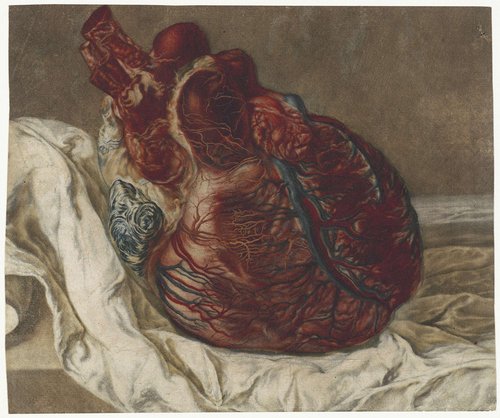
Anatomische studie van een menselijk hart
1700 - 1750
Medium
paper
Dimensions
188; 227
Rights
Public Domain
About this artwork
collector's mark: Lugt 2228
Art Historical Context
In this finely detailed drawing on paper, a human heart is shown dissected to reveal its internal chambers and a delicate network of blood vessels. The organ rests on a white cloth, its deep reds and subtle browns rendered with careful shading that captures the textures of muscle and tissue. Fine lines trace the veins across the surface, while the background remains a soft, neutral tone that keeps attention on the anatomical subject. Jan l’Admiral created this anatomical study between 1700 and 1750. Such works were made to support medical education, combining artistic skill with scientific observation. The drawing’s precision reflects the period’s growing emphasis on accurate visual records for physicians and students. Housed in the Rijksmuseum, the piece remains a clear example of eighteenth-century anatomical illustration. Its careful technique continues to invite viewers to appreciate both the structure of the heart and the artistry involved in recording it.
About the Artist
Jan l'Admiral · 1699–1773
Jan l'Admiral (1699–1773) was a pioneering Dutch engraver whose mastery of color mezzotint technique and collaboration with leading anatomists made him a crucial figure in both artistic printmaking and scientific illustration. Born in Amsterdam in 1699 to an engraver father of the same name, l'Admiral belonged to a family of printmakers and received training that would position him at the forefron...