
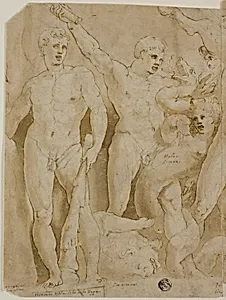
Ancient Sarcophagus Relief with the Labors of Hercules
Medium
Pen and brown ink with brush and brown wash, and traces of black chalk, on buff laid paper, pieced at center
Dimensions
23 × 32 cm (9 1/16 × 12 5/8 in.)
Classification
ink with wash
Department
Prints and Drawings
Museum
Art Institute of Chicago
Accession Number
110324
Rights
Public Domain
Art Historical Context
This drawing by Girolamo da Carpi captures the dynamic scenes from an ancient Roman sarcophagus relief illustrating the Labors of Hercules. Created in pen and brown ink with brush and wash over black chalk on laid paper, the work reflects the Renaissance fascination with classical antiquity. Da Carpi, active in Ferrara and influenced by Mannerist tendencies, carefully recorded the muscular figures and narrative episodes—such as Hercules battling the Nemean lion or capturing the Erymanthian boar—to study ancient composition and anatomy. During the sixteenth century, artists like da Carpi traveled to Rome to sketch surviving monuments, using such studies to inform their own paintings and sculptures. This sheet, pieced at the center and measuring roughly 23 by 32 centimeters, likely served as both a documentary record and a source of inspiration, preserving details of a sarcophagus that may no longer survive intact. Its presence in the Art Institute of Chicago’s Prints and Drawings collection highlights how Renaissance drawings bridged ancient mythology with later European art traditions. The medium of ink and wash allows for dramatic contrasts of light and shadow, emphasizing the relief’s three-dimensional quality on a flat surface. Visitors can appreciate how da Carpi’s precise linework conveys both the heroic energy of Hercules and the enduring cultural importance of these myths across centuries.