
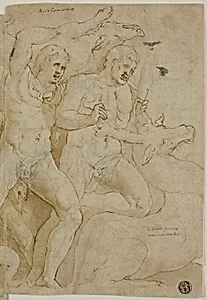
Ancient Sarcophagus Relief with the Labors of Hercules
Medium
Pen and brown ink with brush and brown wash, and traces of black chalk, on buff laid paper, pieced at center
Dimensions
23 × 32 cm (9 1/16 × 12 5/8 in.)
Classification
ink with wash
Department
Prints and Drawings
Museum
Art Institute of Chicago
Accession Number
110325
Rights
Public Domain
Art Historical Context
In the Prints and Drawings collection of the Art Institute of Chicago sits a captivating Renaissance drawing by Girolamo da Carpi (c. 1501–1556), an Italian known for his intricate studies of classical antiquities. Titled *Ancient Sarcophagus Relief with the Labors of Hercules*, this undated work (23 × 32 cm) captures scenes from a Roman sarcophagus, illustrating the heroic feats of Hercules—such as slaying the Nemean Lion or capturing the Erymanthian Boar. These myths, symbols of strength and triumph over chaos, were beloved in antiquity and revived during the Renaissance as emblems of human potential. Executed in pen and brown ink with brush and brown wash, accented by traces of black chalk on buff laid paper, the sheet reveals da Carpi's masterful technique. The paper's central piecing—likely to accommodate the composition—highlights the artist's dedication to precision, blending fine lines for detail with subtle washes for depth and shadow. This method echoes the era's scholarly pursuit of ancient Roman art, as Renaissance draughtsmen like da Carpi copied sarcophagi to fuel the revival of classical forms in painting and sculpture. A testament to 16th-century antiquarian passion, this drawing bridges ancient mythology and early modern artistry, inviting us to marvel at Hercules' enduring legacy through da Carpi's skilled eye.