
Andiron (one of pair)
c. 1939
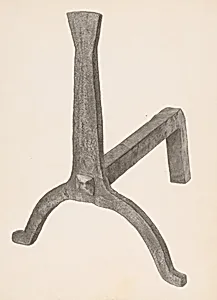
Medium
graphite on paperboard
Dimensions
overall: 30.2 x 22.2 cm (11 7/8 x 8 3/4 in.) Original IAD Object: 12 1/2" high; 10 7/8" deep; 10 3/16" wide; thickness of shaft: 1/2"
Classification
Index of American Design
Department
CG-W
Museum
National Gallery of Art, Washington, D.C.
Credit
Index of American Design
Accession Number
1943.8.8210
Rights
Public Domain
Art Historical Context
This delicate graphite drawing on paperboard captures one of a pair of andons—ornate metal supports for firewood in traditional fireplaces—crafted in a style reflective of early American craftsmanship. Created around 1939 by artist Maurice Van Felix, the work measures 30.2 x 22.2 cm and meticulously documents an original object standing 12 1/2 inches high, with a 10 7/8-inch depth and 10 3/16-inch width. Van Felix's precise lines and shading highlight the andiron's sculptural form, from its sturdy shaft (1/2-inch thick) to decorative flourishes, evoking the functional beauty of colonial-era hearth accessories. As part of the Index of American Design (IAD), a landmark WPA Federal Art Project from the 1930s, this piece belongs to a vast archive of over 15,000 renderings that preserved everyday American folk art and design during the Great Depression. Housed in the National Gallery of Art's CG-W department, it celebrates the ingenuity of American makers, blending utility with artistry in objects that warmed homes and told stories of daily life. These andirons, often forged from iron or brass, were status symbols in 18th- and 19th-century households, their motifs drawing from European influences adapted to New World tastes. Van Felix's drawing ensures their legacy endures, inviting us to appreciate how simple tools embodied cultural heritage.
About the Artist
Maurice Van Felix
Maurice Van Felix was born on March 16, 1889, in Łódź, Poland, and later became a prominent figure in American art circles after immigrating to the United States. His early training took place in Poland and France, where he honed his skills as a painter and etcher before settling in Brooklyn, New York, by 1919. Though details of his formal education remain sparse, Van Felix quickly established him...