
Andrew Johnson
Medium
Classification
Department
Smithsonian Collection
Museum
Smithsonian American Art Museum
Credit
National Portrait Gallery, Smithsonian Institution
Accession Number
NPG.69.70
Rights
Public Domain
Tags
Art Historical Context
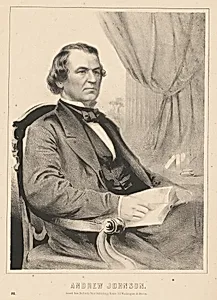
This lithographic print by John Henry Bufford, created around 1864, captures Andrew Johnson at a pivotal moment in American history. Bufford, a leading 19th-century lithographer known for his detailed reproductive prints, depicts Johnson seated at a desk with a quill, book, and chair—symbols of authority and intellect. The portrait highlights Johnson's humble origins as a tailor from Tennessee, where he rose from mayor to U.S. Senator, Vice President, and eventually the 17th President after Abraham Lincoln's assassination in 1865. Produced during the Civil War era, just as Johnson was elected Lincoln's running mate on the National Union ticket, this image served as an accessible form of political imagery. Prints like this were mass-produced and widely distributed, making presidential figures familiar to the public in an age before photography dominated. Johnson's stern gaze and simple attire nod to his self-made story, contrasting with the era's more ornate portraits. Housed in the Smithsonian American Art Museum's collection from the National Portrait Gallery, this work exemplifies how lithography democratized portraiture, blending artistry with cultural propaganda to shape public perception of leaders during national turmoil.