
Androcles and the Lion
c. 1722 - c. 1728
Medium
Bentheim sandstone
Dimensions
3347; 96; 797; 97; 89; 1095; 1152; 89; 96; 250
Rights
Public Domain
About this artwork
? acquired from the artist by Jacob Alewyn Ghyzen (d. 1760), c. 1722-28; his garden, country house Bos en Hoven, Heemstede, first recorded around 1732;{_Het Zegepralent Kennemerlant_, c. 1732, vol. 2, no. 98. Written communication by the late Pieter Fischer, 1 May 1991.} …; from the dealer Raoul Heilbronner, Geneva, on loan to the museum, 1924; by whom donated to the museum, 1925
Art Historical Context
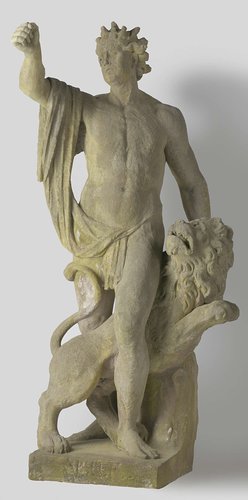
**Androcles and the** is a monumental sculpture by Flemish artist Jan Pieter van Baursit (I), created around 1722–1728. Carved from Bentheim sandstone—a durable, fine-grained stone quarried in Germany and prized for its weather resistance in outdoor settings—this work stands approximately 250 cm tall and weighs 797 kg, making it an imposing garden feature. Van Baurscheit, of a noted family of sculptors from Mechelen and Antwerp, specialized in lively Baroque figures, capturing dynamic poses and expressive details that bring classical tales to life. The sculpture depicts the ancient Roman fable of Androcles, a slave who befriends a lion by removing a thorn from its paw, only to be spared by the grateful beast in the arena. Commissioned around 1722–28 by Dutch collector Jacob Alewyn Ghyzen for his estate garden at Bos en Hoven in Heemstede, it was first documented in 1732 in *Het Zegepralent Kennemerlant*. Such garden statues were fashionable in 18th-century Netherlands, blending moral storytelling with opulent landscaping to delight and educate visitors. Later acquired by Geneva dealer Raoul Heilbronner, it was loaned to the museum in 1924 before his donation in 1925. This piece exemplifies the era's fusion of antiquity and Rococo exuberance, inviting us to ponder themes of compassion across species and time.