
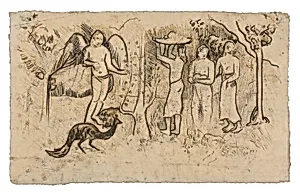
Angel, Peacock, and Three Tahitians
c. 1902
Medium
Transfer drawing in brown and black ink on cream Japanese paper
Dimensions
24.6 × 39.6 cm (9 11/16 × 15 5/8 in.)
Classification
monotype
Department
Prints and Drawings
Museum
Art Institute of Chicago
Accession Number
31753
Rights
Public Domain
Art Historical Context
In the final years of his life, Paul Gauguin created *Angel, Peacock, and Tahitians* around 1902, during his immersive stay in the South Pacific. This intimate monotype— a unique print made by drawing ink onto a surface and transferring it under pressure to paper—captures the artist's enduring fascination with Tahitian culture. Gauguin, a Post-Impressionist pioneer, fled Europe's industrialization for Polynesia, where he blended exotic island life with symbolic, dreamlike imagery. Here, ethereal Tahitian figures coexist with a majestic peacock and a celestial angel, evoking a mystical fusion of Polynesian spirituality, Christian motifs, and nature's splendor. Executed in brown and black inks on delicate cream Japanese paper, this 24.6 × 39.6 cm work exemplifies Gauguin's experimental printmaking. Monotypes like this are one-of-a-kind, unlike repeatable etchings, allowing spontaneous, painterly effects that mirror his bold colors and flattened forms in oils. Housed in the Art Institute of Chicago's Prints and Drawings department, it reflects his late-career innovations amid poverty and illness on the Marquesas Islands, just before his death in 1903. This piece invites visitors to ponder Gauguin's quest for an earthly paradise, where Western symbolism meets indigenous grace—a poignant snapshot of his revolutionary vision.
About the Artist
Paul Gauguin · 1848–1903
Paul Gauguin (1848-1903) was a French Post-Impressionist painter whose bold experiments with color, form, and subject matter made him one of the most influential figures in the transition from 19th-century art to modernism. His rejection of European civilization for the perceived authenticity of 'primitive' cultures established an archetype of artistic exile that continues to resonate. Gauguin's ...