
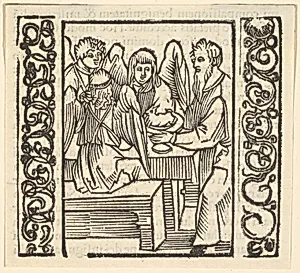
Angels Served at a Table, illustration from Speculum Passionis, 1507
Medium
Woodcut with letterpress text verso
Classification
Prints
Department
Drawings and Prints
Museum
Metropolitan Museum of Art, New York, NY
Credit
Harris Brisbane Dick Fund, 1917
Accession Number
17.3.3034
Rights
Public Domain
Tags
Art Historical Context
**Angels Served at a**, a captivating woodcut illustration from the1507 *Speculum Passionis*Mirror of the Passion), comes from the masterful hand of Hans Baldung Grien, a leading German artist of the Northern Renaissance. Trained under Albrecht Dürer, Baldung was renowned for his intricate woodcuts that blended religious devotion with dramatic expressiveness. This print, part of a devotional book meditating on Christ's Passion, depicts angels attending a table—evoking heavenly service amid sacred narratives, a motif blending the divine with the earthly to inspire contemplation. Created as a woodcut with letterpress text on the verso, the work exemplifies early 16th-century printmaking techniques. Woodcuts allowed affordable dissemination of complex imagery through books, making profound religious art accessible beyond elite patrons. Baldung's precise carving yields rich tonal contrasts and fluid lines, heightening the ethereal quality of the angels and the symbolic table, central to Eucharistic themes. Housed in The Metropolitan Museum of Art's Drawings and Prints department (Harris Brisbane Dick Fund, 1917), this piece reflects the era's fervor for illustrated prayer books amid pre-Reformation spirituality. It invites visitors to ponder how such prints bridged the mortal and mystical, fostering personal piety in turbulent times.
About the Artist
Hans Baldung (called Hans Baldung Grien) · 1484–1545
Hans Baldung Grien (1484/85–1545), born in Schwäbisch Gmünd into an erudite family of jurists and physicians, forsook academia to pursue art. His early training around 1500 took place in the Upper Rhineland, likely Strasbourg, before he apprenticed under Albrecht Dürer in Nuremberg from 1503 to 1507. There, the young artist honed his skills in painting, printmaking, and stained glass, even managin...