
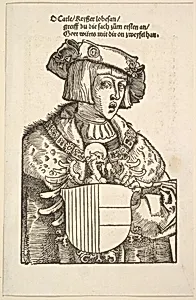
Portrait of Charles V
Medium
Woodcut and letterpress text
Dimensions
Sheet: 7 1/4 x 4 3/4 in. (18.4 x 12 cm)
Classification
Prints
Department
Drawings and Prints
Museum
Metropolitan Museum of Art, New York, NY
Credit
Harris Brisbane Dick Fund, 1928
Accession Number
28.97.78
Rights
Public Domain
Tags
Art Historical Context
Behold the striking *Portrait of Charles V* by Hans Baldung Grien, a masterful German artist of the Northern Renaissance (c. 1484–1545), renowned for his expressive woodcuts and ties to Albrecht Dürer’s workshop. This intimate print captures the Holy Roman Emperor Charles V, whose vast empire spanned Europe and the Americas during the 16th century. Though the exact date is unknown, it reflects the era’s fascination with powerful rulers, blending regal portraiture with heraldic symbols like the emperor’s coat of arms, which underscore his imperial authority and lineage. Crafted as a woodcut with letterpress text on a modest sheet (7¼ × 4¾ in.), this work highlights the revolutionary printmaking techniques of the Renaissance. Woodcuts allowed artists like Baldung—nicknamed "Grien" for his fondness of green hues—to produce detailed, affordable images for wide dissemination, from noble courts to common households. The fine lines and textures evoke the emperor’s stern gaze and ornate attire, while the integrated text likely adds a motto or title, enhancing its role as both art and propaganda. Housed in the Metropolitan Museum of Art’s Drawings and Prints department (Harris Brisbane Dick Fund, 1928), this piece exemplifies how prints democratized portraiture, immortalizing Charles V’s likeness amid the Reformation’s upheavals. A testament to Baldung’s versatility beyond his famous macabre works, it invites us to ponder the face behind one of history’s most influential reigns.
About the Artist
Hans Baldung (called Hans Baldung Grien) · 1484–1545
Hans Baldung Grien (1484/85–1545), born in Schwäbisch Gmünd into an erudite family of jurists and physicians, forsook academia to pursue art. His early training around 1500 took place in the Upper Rhineland, likely Strasbourg, before he apprenticed under Albrecht Dürer in Nuremberg from 1503 to 1507. There, the young artist honed his skills in painting, printmaking, and stained glass, even managin...