
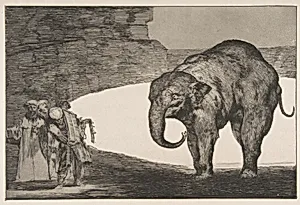
'Animal Folly' from the 'Disparates' (Follies / Irrationalities)
ca. 1815–19 (published before 1877)
Medium
Etching, aquatint, drypoint on Japan paper
Dimensions
Plate: 9 5/8 × 13 3/4 in. (24.5 × 35 cm) Sheet: 10 13/16 x 15 1/8 in. (27.5 x 38.4 cm)
Classification
Prints
Department
Drawings and Prints
Museum
Metropolitan Museum of Art, New York, NY
Credit
Rogers Fund, 1922
Accession Number
22.63.147
Rights
Public Domain
Tags
Art Historical Context
Francisco de Goya y Lucientes, the visionary Spanish artist of the late 18th and early 19 centuries, created *Animal Folly* as part of his enigmatic series *Disparates* ( known as *Foll* or *Irrationalities produced around 1815–. Unpublished during Goya's lifetime and not released until before 1877, these 22 etchings delve into the absurdities of human behavior, superstition, and societal madness. This print, now in the Metropolitan Museum of Art's Drawings and Prints department (acquired via the Rogers Fund in 1922), captures a surreal scene of men and elephants entangled in folly, embodying Goya's sharp critique of irrationality. Goya's mastery shines in the mixed-media technique: etching for precise lines, aquatint for moody tonal depths, and drypoint for velvety burrs that add emotional intensity. Printed on fine Japan paper, the plate measures 9⅝ × 13¾ inches, allowing intricate details to emerge. This combination produces haunting, dreamlike contrasts, bridging Enlightenment reason with Romantic darkness—a hallmark of Goya's late style, influenced by his deafness and Spain's turbulent post-Napoleonic era. *Animal Folly* invites viewers to ponder humanity's animalistic impulses, much like Goya's earlier *Los Caprichos*. Its cultural resonance lies in exposing timeless follies, making it a provocative gem for modern audiences reflecting on power, spectacle, and the grotesque.
About the Artist
Goya (Francisco de Goya y Lucientes) · 1746–1828
Francisco José de Goya y Lucientes (1746-1828) was a Spanish painter and printmaker considered the last of the Old Masters and the first of the moderns. Rising from modest provincial origins to become First Court Painter to Charles IV, Goya's career spanned the Enlightenment's optimism and the brutal Napoleonic invasion that shattered it. A mysterious illness in 1793 left him permanently deaf and ...