
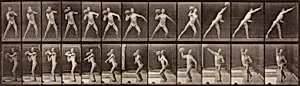
Animal Locomotion, Plate 319
Medium
Collotype, from "Animal Locomotion"
Dimensions
Image: 13.5 × 46.2 cm (5 3/8 × 18 1/4 in.); Paper: 34.8 × 49.9 cm (13 3/4 × 19 11/16 in.); Mount: 48.3 × 61.3 cm (19 1/16 × 24 3/16 in.)
Classification
photograph
Department
Photography and Media
Museum
Art Institute of Chicago
Accession Number
195558
Rights
Public Domain
Art Historical Context
Eadweard Muybridge’s *Animal Locomotion, Plate 319* (1887) captures a precise sequence of movement in a single collotype print. Part of his groundbreaking eleven-volume publication *Animal Locomotion*, the work reflects Muybridge’s pioneering use of multiple cameras triggered in rapid succession to dissect motion too swift for the naked eye. Commissioned initially to settle debates about equine gait, the project expanded to document humans and animals alike, laying essential groundwork for the development of motion pictures. Printed as a collotype—a high-quality photographic process capable of rendering fine tonal gradations—this plate exemplifies the intersection of scientific inquiry and artistic vision. Muybridge’s grid-like arrangements of sequential frames transformed photography from a static medium into a tool for analyzing time and movement. Today, the print resides in the Art Institute of Chicago’s collection of photography and media, where it continues to invite viewers to appreciate both its empirical precision and its enduring influence on modern visual culture.
About the Artist
Eadweard Muybridge · 1830–1904
Eadweard Muybridge (1830-1904) was an English-American photographer who revolutionized the understanding of motion through his pioneering chronophotographic studies. Born Edward James Muggeridge in Kingston upon Thames, England, he emigrated to America and became famous first for his dramatic landscape photographs of Yosemite Valley, then for his groundbreaking motion studies that proved horses li...