Ctrl K
1830–1904
Eadweard Muybridge (1830-1904) was an English-American photographer who revolutionized the understanding of motion through his pioneering chronophotographic studies. Born Edward James Muggeridge in Kingston upon Thames, England, he emigrated to America and became famous first for his dramatic landscape photographs of Yosemite Valley, then for his groundbreaking motion studies that proved horses lift all four hooves off the ground while galloping. His masterwork, 'Animal Locomotion' (1887), comprised 781 plates with over 20,000 images documenting human and animal movement, fundamentally changing how artists depicted motion and laying the groundwork for cinema. His invention of the zoopraxiscope—a device for projecting sequential photographs to create the illusion of movement—made him a direct precursor to motion pictures.
Born April 9, 1830, in Kingston upon Thames, Muybridge emigrated to America around 1850, settling first in New York before moving to San Francisco to work in publishing and bookselling. A severe stagecoach accident in 1860 left him with head injuries that may have affected his personality; doctors recommended outdoor work for his recovery, leading him to take up photography.
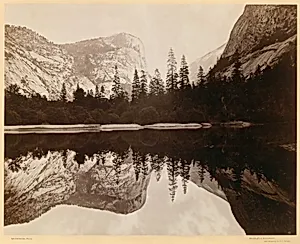
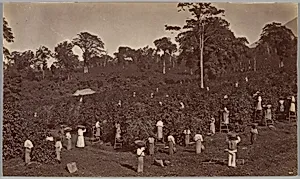
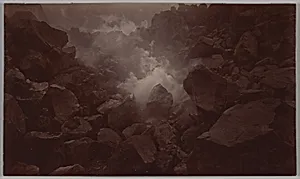
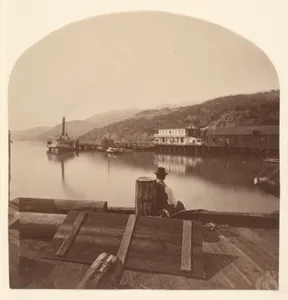
Returning to San Francisco in 1867, he established himself as a landscape photographer, adopting the professional name 'Helios.' His dramatic views of Yosemite Valley, featuring bold compositions and masterful cloud effects achieved through combination printing, brought him international recognition.
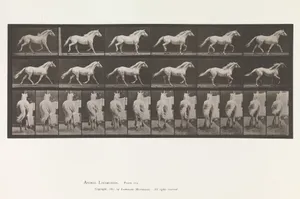
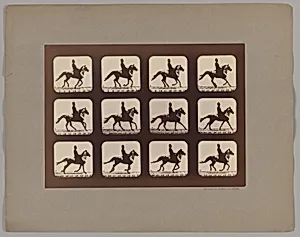
In 1872, railroad magnate Leland Stanford commissioned Muybridge to photograph horses in motion to settle a debate about whether all four hooves left the ground during a gallop. After initial experiments, Muybridge developed an ingenious system using multiple cameras with electromagnetic shutters triggered by trip wires.
In 1878 at Stanford's Palo Alto Stock Farm, Muybridge captured the famous sequence proving that horses do indeed become fully airborne. He invented the zoopraxiscope to project these images in rapid succession, creating one of the earliest forms of motion pictures. His personal life was marred by scandal when he murdered his wife's lover in 1874 but was acquitted on grounds of justifiable homicide.
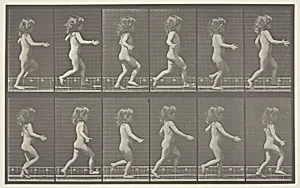
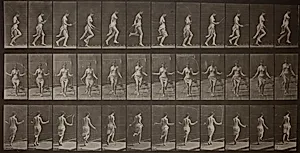
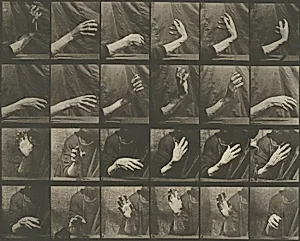
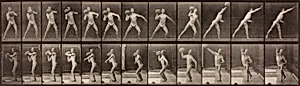
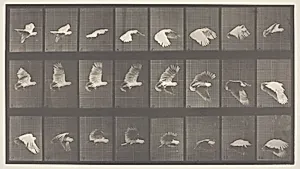
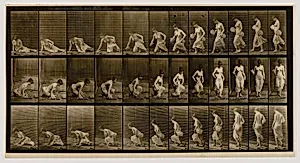
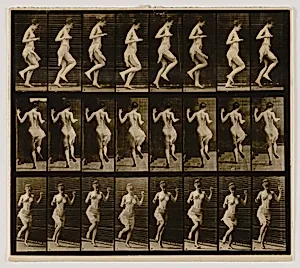
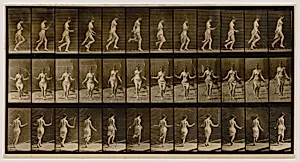
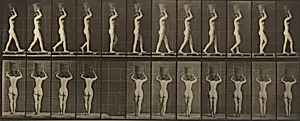
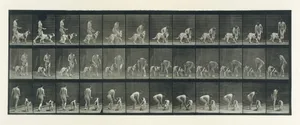
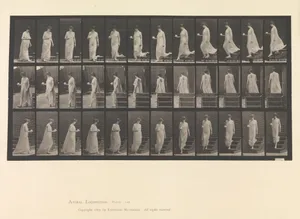
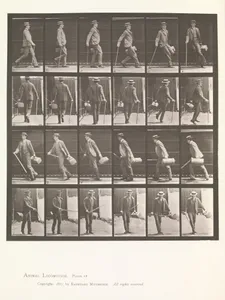
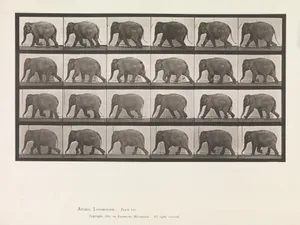
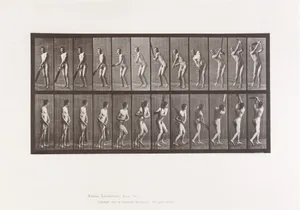
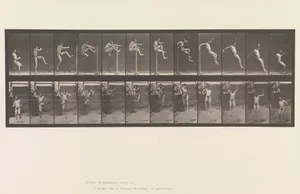
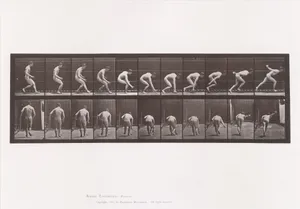
The University of Pennsylvania invited Muybridge to conduct comprehensive motion studies, providing him unprecedented resources and subjects. From 1884 to 1886, he produced over 100,000 photographs documenting humans and animals in every conceivable action—walking, running, jumping, throwing, carrying objects, and performing trades.
The resulting publication, 'Animal Locomotion: An Electro-photographic Investigation of Consecutive Phases of Animal Movements' (1887), contained 781 collotype plates. This monumental work became an essential reference for artists, scientists, and physicians, revealing movements invisible to the naked eye.
At the 1893 World's Columbian Exposition in Chicago, Muybridge presented lectures in the specially built Zoopraxographical Hall—effectively the first commercial movie theater. He charged admission to view his projected motion studies, anticipating cinema by just two years.
Muybridge returned to England in 1894 and spent his final years in Kingston upon Thames, where he died on May 8, 1904. He bequeathed his zoopraxiscope, projector, and a selection of his work to the Kingston Museum.
Biography length: ~950 words
![[Woman Opening Parasol]](https://images.artheonmuseum.org/met/ph/thumb/woman-opening-parasol-268623.webp)
![[Boys Playing Leap Frog]](https://images.artheonmuseum.org/met/ph/thumb/boys-playing-leap-frog-268638.webp)
![[Horse and Rider Galloping]](https://images.artheonmuseum.org/met/ph/thumb/horse-and-rider-galloping-266441.webp)