
Anklet
Unknown Artist
A.D. 3rd century
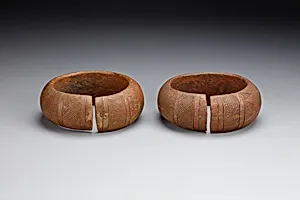
Medium
Bronze
Dimensions
Diam. 11.4 × H. 44.2 cm (4 1/2 × 17 3/8 in.)
Classification
Anklet
Period
Meroitic Period
Department
Egyptian Art
Museum
Metropolitan Museum of Art, New York, NY
Credit
Rogers Fund, 1913
Accession Number
13.125.51a
Rights
Public Domain
Art Historical Context
This elegant bronze anklet hails from the Meroitic Period (ca. 300 B.C.–A.D. 350), a vibrant era in the Kingdom of Kush, centered in ancient Nubia (modern Sudan Crafted in the 3rd century.D., its substantial dimensions—11.4 cm in diameter and 44. cm high—suggest it was designed to encircle the ankle with a bold, cylindrical form, likely worn by elite women to accentuate status and grace during processions or daily life. Acquired through the Rogers Fund in 1913, it now graces the Egyptian Art department at the Metropolitan Museum of Art. The Meroitic kingdom was a powerhouse bridging Egyptian traditions and sub-Saharan African innovations, renowned for its pyramid tombs, ironworking, and trade with Rome and India. Jewelry like this anklet exemplifies their mastery of bronze casting, a technique that allowed for durable, intricately shaped ornaments symbolizing wealth and protection. Such pieces often featured motifs evoking fertility or power, reflecting a culture where adornment was both aesthetic and ritualistic. Today, this anklet offers a tangible link to Meroitic women's lives, highlighting a sophisticated society often overshadowed by its Egyptian neighbors. Its patina whispers of centuries buried in the Nile Valley sands, inviting us to ponder the confident steps of its original owner.