
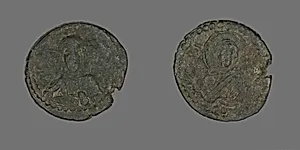
Anonymous Follis (Coin), Attributed to Constantine IX
1042-1055
Medium
Bronze
Dimensions
Diam.: 2.8 cm (1 1/8 in.)
Classification
coin
Department
Arts of Greece, Rome, and Byzantium
Museum
Art Institute of Chicago
Accession Number
36662
Rights
Public Domain
About this artwork
The front (obverse) of this coin shows a frontal image of Christ. On the back (Reverse) Mary is shown.
Art Historical Context
This bronze Anonymous Follis, attributed to the reign of Byzantine Emperor Constantine IX (1042–1055), offers a glimpse into the monetary system of the medieval Byzantine Empire. Measuring just 2.8 centimeters across, this small coin was struck in bronze and circulated widely across the empire’s territories. Unlike earlier imperial issues that featured the emperor’s portrait, these “anonymous” folles omitted personal imagery, reflecting a notable shift in how currency conveyed authority and faith during this period. Housed in the Art Institute of Chicago’s Arts of Greece, Rome, and Byzantium department, the coin highlights the empire’s sophisticated minting practices and its role as a bridge between classical antiquity and the medieval world. Byzantine coinage served not only as a medium of exchange but also as a tool for political stability and religious expression, helping unify diverse regions under a shared cultural and economic framework. The attribution to Constantine IX’s era connects the piece to a time of both prosperity and challenge, when Constantinople remained a vibrant center of trade and artistry. Such artifacts remind visitors of the enduring legacy of Byzantine craftsmanship in shaping European and Mediterranean history.
About the Artist
Byzantine
"Byzantine" is the collective attribution given to anonymous artists working within the Eastern Roman (Byzantine) Empire, whose creations spanned from the 4th to the 15th centuries, primarily in Constantinople and its cultural sphere. These masters produced a vast body of art that defined an era, with museums like the Walters Art Museum and the Art Institute of Chicago cataloging numerous works un...