
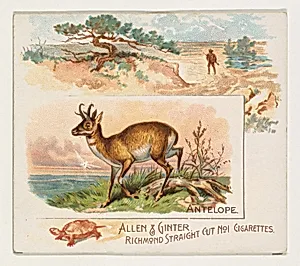
Antelope, from Quadrupeds series (N41) for Allen & Ginter Cigarettes
Medium
Commercial color lithograph
Dimensions
Sheet: 2 7/8 x 3 1/4 in. (7.3 x 8.3 cm)
Classification
Prints|Ephemera
Department
Drawings and Prints
Museum
Metropolitan Museum of Art, New York, NY
Credit
The Jefferson R. Burdick Collection, Gift of Jefferson R. Burdick
Accession Number
63.350.202.41.1
Rights
Public Domain
Tags
Art Historical Context
Behold the graceful *Antelope* from Allen & Ginter'srupeds series (N), a delightful 1890 commercial color lithograph measuring just 2 7/8 x 3 1/4 inches. Produced by the innovative tobacco firm Allen & Ginter in collaboration with designers Lindner, Eddy &, this tiny print was one of many inserted into cigarette packs to entice collectors and boost sales during the Gilded Age. Part of a popular series showcasing exotic animals, it captures theelope's elegant form in vivid detail, transforming everyday ephemera into cherished keepsakes. Chromolithography, the medium here, revolutionized commercial printing in the late 19th century, allowing for vibrant, multi-color reproductions at scale—far more affordable than hand-painted works. These cards bridged art and advertising, blending scientific illustration with eye-catching appeal to educate and entertain a broad audience, from children to adults. Today, classified as prints and ephemera in the Metropolitan Museum of Art's Drawings and Prints department, it reflects the era's burgeoning consumer culture. Housed in The Jefferson R. Burdick Collection—a landmark gift of over 30,000 cards—this piece highlights how disposable promotions became enduring cultural artifacts, preserving glimpses of natural history amid America's tobacco boom. A charming window into Victorian-era collecting!
About the Artist
Allen & Ginter|Lindner, Eddy & Claus
Allen & Ginter, the pioneering American tobacco firm based in Richmond, Virginia, emerged around 1880 from the partnership of John F. Allen and Lewis Ginter, evolving from Allen's earlier John F. Allen & Company. Allen retired in 1882, succeeded by John Pope, yet the brand endured under Ginter's leadership, employing over 1,100 workers—mostly women—for hand-rolled cigarettes by 1886. Ginter, a Dut...