
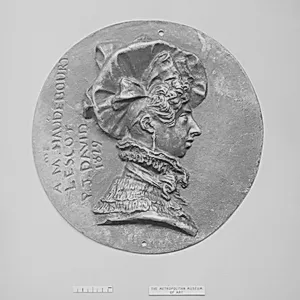
Antoinette Cécile Hortense Lescot, Mme. Haudebourt-Lescot, painter
Medium
Bronze, cast
Dimensions
Diameter: 5 7/8 in. (14.9 cm)
Classification
Medals and Plaquettes
Culture
French
Department
European Sculpture and Decorative Arts
Museum
Metropolitan Museum of Art, New York, NY
Credit
Gift of Samuel P. Avery, 1898
Accession Number
98.7.16
Rights
Public Domain
Tags
Art Historical Context
Behold this exquisite bronze medal, *Antoinette Cécile Hortenseescot, Mme. Haudebourt-Lesc, painter* (1829), crafted by the renowned French sculptor Pierre-Jean David'Angers. With a diameter of just 5 7/8 inches, this intimate profile portrait captures the likeness of a pioneering female artist in a medium that blends sculpture's precision with the intimacy of personal commemoration. Cast in bronze, it exemplifies the 19th-century revival of classical medallic art, where small-scale works served as portable tributes to cultural luminaries. Mme. Haudebourt-Lescot (1784–1848) was a celebrated neoclassical painter, one of the few women to achieve prominence in France's male-dominated art world during the Napoleonic era and beyond. David d'Angers, a leading Romantic sculptor known for his lifelike portraits of intellectuals and revolutionaries, immortalized her in profile—a nod to ancient Roman coins that emphasized dignity and intellect. Created in 1829 amid France's shifting political landscape under the Bourbon Restoration, the medal reflects the era's fascination with honoring artists who bridged Enlightenment ideals and emerging Romantic individualism. Housed in the Metropolitan Museum of Art's European Sculpture and Decorative Arts department since its 1898 gift by Samuel P. Avery, this piece highlights women's contributions to art history. Its classical profile technique showcases David's mastery of surface modeling, making her gaze both timeless and profoundly human—inviting us to reflect on the enduring legacy of creative trailblazers.
About the Artist
Pierre Jean David d'Angers · 1788–1856
Pierre-Jean David d'Angers, born on March 12, 1788, in Angers, France, to a wood carver and ornamental sculptor father who had fought in the Republican army, began his artistic training locally under Marchand and Jean-Jacques Delusse at the École centrale d'Angers from 1806 to 1807. In 1808, he arrived in Paris with scant funds and entered the studio of Philippe-Laurent Roland, later working under...