
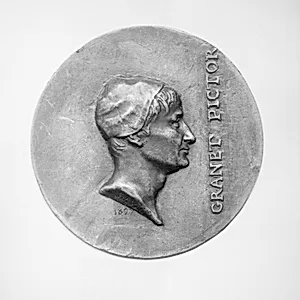
François Marie Granet (1777–1849)
Medium
Bronze, cast - single
Dimensions
Diameter: 5 in. (12.7 cm)
Classification
Medals and Plaquettes
Culture
French
Department
European Sculpture and Decorative Arts
Museum
Metropolitan Museum of Art, New York, NY
Credit
Gift of Samuel P. Avery, 1898
Accession Number
98.7.21
Rights
Public Domain
Tags
Art Historical Context
This exquisite bronze medal, created in 1827 by the renowned French Romantic sculptor Pierre-Jean David dAngers, portrays the painter François Marie Granet (7–1849) in a precise profile view. Measuring just 5 inches in diameter, it exemplifies the intimate artistry of 19th-centuryquettes—small, cast reliefs prized for their portability and detail. David d'Angers, a master of portraiture who produced over 500 such medals, Granet's dignified features with sharp contours and subtle modeling, highlighting his status as a celebrated landscape and architectural painter influenced by Neoclassicism. Historically, this piece reflects the cultural vibrancy of post-Napoleonic France during the Bourbon Restoration, when medals served as personal tributes among intellectuals and artists. Granet, known for his luminous Roman interiors, was a contemporary whose work bridged Neoclassicism and Romanticism, much like David d'Angers' own expressive style. The single-cast bronze technique underscores its rarity, emphasizing the sculptor's skill in low-relief carving for lifelike depth. A generous gift to the Metropolitan Museum of Art in 1898 from collector Samuel P. Avery, this medal invites visitors to appreciate the era's fascination with heroic individualism, frozen in miniature bronze brilliance.
About the Artist
Pierre Jean David d'Angers · 1788–1856
Pierre-Jean David d'Angers, born on March 12, 1788, in Angers, France, to a wood carver and ornamental sculptor father who had fought in the Republican army, began his artistic training locally under Marchand and Jean-Jacques Delusse at the École centrale d'Angers from 1806 to 1807. In 1808, he arrived in Paris with scant funds and entered the studio of Philippe-Laurent Roland, later working under...