
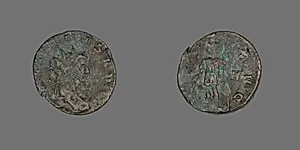
Antoninianus (Coin) Portraying Emperor Gallienus
260-268
Medium
Billon
Dimensions
Diam.: 1.9 cm (3/4 in.)
Classification
coin
Department
Arts of Greece, Rome, and Byzantium
Museum
Art Institute of Chicago
Accession Number
142615
Rights
Public Domain
About this artwork
The front (obverse) of this coin portrays the emperor Gallienus, facing right and wearing a radiant crown.
Art Historical Context
This small yet mighty Antoninianus coin, struck during the turbulent reign of Emperor Gallienus (r. 253–268 CE), captures the essence of Roman imperial propaganda in miniature. Made of billon—a debased alloy of silver and base metals—the 1.9 cm diameter disc features Gallienus on the obverse, typically adorned with a radiate crown symbolizing solar divinity and divine favor. The reverse likely bears a deity, victory motif, or imperial legend, affirming the emperor's authority amid chaos. Gallienus ruled during the Crisis of the Third Century, a period of relentless barbarian invasions, civil wars, and economic collapse that nearly shattered the empire. As coins like this circulated widely across the Roman world, they served not just as currency but as portable billboards of legitimacy, rallying loyalty in an era when over 20 emperors rose and fell in 50 years. Crafted via die-striking—a precise technique pressing designs into metal blanks—this artifact from the Art Institute of Chicago's Arts of Greece, Rome, and Byzantium collection highlights Roman minting artistry. Its modest size belies its cultural weight: everyday objects that preserved history, economy, and imperial myth for posterity.
About the Artist
Ancient Roman
The artists attributed to "Ancient Roman" in museum collections represent the anonymous craftsmen who produced the vast output of sculpture, frescoes, mosaics, and reliefs defining Roman visual culture from the Republic (c. 509–27 BCE) to the late Empire (c. 395 CE). Individual identities remain elusive, as Roman makers were typically viewed as skilled tradesmen—often enslaved Greeks or provincial...