
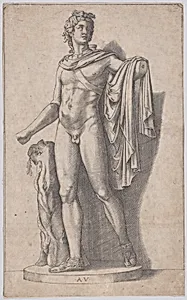
Apollo
ca. 1514–36
Medium
Engraving
Dimensions
10 9/16 x 6 3/8 in. (26.9 x 16.2 cm)
Classification
Prints
Department
Drawings and Prints
Museum
Metropolitan Museum of Art, New York, NY
Credit
Rogers Fund, 1962
Accession Number
62.602.138
Rights
Public Domain
Tags
Art Historical Context
Agostino Veneziano’s engraving *Apollo*, created between 1514 and 1536, captures the Greek god of music, poetry, and the sun in a poised, idealized male nude. Working in the vibrant artistic circles of Renaissance Venice and Rome, Veneziano was among the most skilled printmakers of his generation, translating the fluid forms of classical sculpture and contemporary painting into the precise lines of engraving. The medium allowed this refined image to circulate widely, bringing the beauty of antique ideals to collectors and artists across Europe. The choice of subject reflects the period’s deep fascination with classical antiquity. Apollo, often shown with attributes such as a lyre or bow, embodied harmony, intellect, and physical perfection—qualities Renaissance humanists sought to revive. Veneziano’s confident handling of anatomy and balanced composition demonstrates how engravers helped shape the visual language of the High Renaissance, turning mythological figures into enduring symbols of cultural aspiration. Measuring just over ten by six inches, the print’s intimate scale invites close looking, rewarding viewers with the delicate cross-hatching and luminous modeling that define Veneziano’s technique. Today it resides in the Metropolitan Museum’s collection of prints, offering a window onto both the technical brilliance of early printmaking and the enduring appeal of classical mythology.