
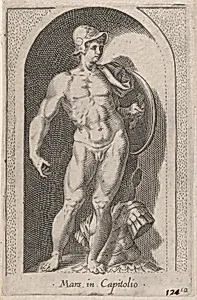
Speculum Romanae Magnificentiae: Mars (Mars in Capitolio)
16th century
Medium
Engraving
Dimensions
sheet: 16 5/8 x 13 1/8 in. (42.3 x 33.3 cm) plate: 4 15/16 x 3 1/8 in. (12.5 x 8 cm)
Classification
Prints
Department
Drawings and Prints
Museum
Metropolitan Museum of Art, New York, NY
Credit
Harris Brisbane Dick Fund, 1941
Accession Number
41.72(2.161)
Rights
Public Domain
Tags
About this artwork
Speculum Romanae Magnificentiae: Mars (Mars in Capitolio) is a prints by |French|French artist Anonymous|Philippe Thomassin|Antonio Lafreri, created in 16th century. The work was created using engraving. It measures sheet: 16 5/8 x 13 1/8 in. (42.3 x 33.3 cm) plate: 4 15/16 x 3 1/8 in. (12.5 x 8 cm). Printmaking during this period was an essential medium for disseminating artistic imagery and ideas across broad audiences. The technique involved careful preparation of printing surfaces and meticu...
Art Historical Context
Step into the Renaissance fascination with ancient Rome through *Speculum Romanae Magnificentiae: Mars (Mars in Capitolio)*, a 16th-century engraving attributed to anonymous artists, Philippe Thomassin, or publisher Antonio Lafreri. print captures the mighty Roman god of war, Mars, likely evoking a statue or monument on Rome's Capitoline Hill—a site steeped in imperial glory and classical mythology. Part of Lafreri's renowned *Speculum* series, it exemplifies how prints preserved and popularized Rome's antiquities for scholars, travelers, and collectors across Europe. Engraving, the medium here, involved incising intricate lines into a metal plate for inking and printing, allowing precise details and multiple impressions. At just 4 15/16 x 3 1/8 inches on the plate (within a larger 16 5/8 x 13 1/8-inch sheet), these compact works were ideal for albums, blending artistry with documentation. They fueled the era's humanist revival, bridging ancient grandeur with modern appreciation. Acquired via the Harris Brisbane Dick Fund in 1941, this piece resides in the Metropolitan Museum of Art's Drawings and Prints department, offering visitors a tangible link to Rome's enduring legacy. A testament to printmaking's power, it invites us to marvel at how ink on paper immortalized the gods.
About the Artist
Anonymous|Philippe Thomassin|Antonio Lafreri
In the vast tapestry of art history, "Anonymous" stands not as a singular individual but as a collective designation for countless unidentified creators whose works have endured across millennia. These artists, spanning prehistoric cave painters to medieval illuminators and folk craftsmen, produced the foundational layers of human visual culture. Prior to the Renaissance, when individual fame emer...