
Apollo
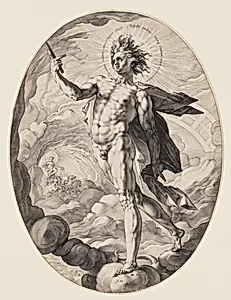
Medium
Engraving on ivory laid paper
Dimensions
Sheet (trimmed): 35 × 26.4 cm (13 13/16 × 10 7/16 in.)
Classification
engraving
Department
Prints and Drawings
Museum
Art Institute of Chicago
Accession Number
268231
Rights
Public Domain
Art Historical Context
Behold Hendrick Goltzius's *Apollo* (1588), a engraving on ivory laid paper, now housed in the Art Institute of Chicago's Prints Drawings Department. Measuring 35 × 26.4 cm, this trimmed sheet captures the radiant Greek god of the sun, music, and prophecy in dynamic pose, exemplifying the Northern Mannerist style that flourished in the late 16th-century Netherlands. Goltzi, a Haarlem-based virtuoso engraver, revolutionized printmaking with his innovative "swelling line" technique—a bold, undulating stroke that mimics the fluidity of brushwork, blurring the line between engraving and painting. Created during a period of artistic exchange between Italy and the North, *Apollo* reflects the Renaissance fascination with classical mythology, portraying the deity as an emblem of harmony and enlightenment amid Europe's religious upheavals. This engraving's significance lies in its technical brilliance: ivory laid paper enhanced the ink's luminosity, allowing Goltzius's intricate cross-hatching to evoke three-dimensional form and shimmering light. Prized by collectors, it showcases how prints democratized access to grand subjects, bridging elite patronage and broader audiences in the age of discovery. A testament to Goltzius's genius, *Apollo* invites us to marvel at the engraver's hand as a portal to antiquity.
About the Artist
Hendrick Goltzius · 1558–1617
Hendrick Goltzius (1558–1617) was the most celebrated engraver of the Northern Renaissance and a pivotal figure in Dutch Mannerism. Born near the German-Dutch border, Goltzius transformed printmaking into a virtuoso art form through his revolutionary 'swelling line' technique, where the burin was manipulated to create lines of varying thickness that produced unprecedented tonal effects and three-d...