
Apollo and Coronis.
1652–1725
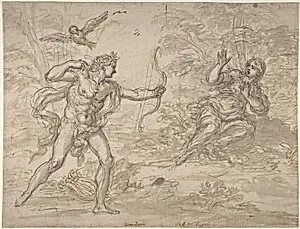
Medium
Pen and brown ink, brush and brown wash, over black chalk
Dimensions
sheet: 10 7/16 x 13 5/8 in. (26.5 x 34.6 cm)
Classification
Drawings
Department
Drawings and Prints
Museum
Metropolitan Museum of Art, New York, NY
Credit
The Elisha Whittelsey Collection, The Elisha Whittelsey Fund, 1961
Accession Number
61.174
Rights
Public Domain
Tags
Art Historical Context
Giovanni Battista Foggini1652–1725), a prominent Florentine Baroque, captures a dramatic moment from Greek mythology *Apollo and Coronis*. drawing depicts the god Apollo, bow in hand, alongside the mortal Coronis—his lover whose infidelity led to her tragic demise by his arrow, as foretold by a raven. This scene evokes the intense passions and divine retribution central to classical tales, rendered with Baroque flair for movement and emotion. Executed in pen and brown ink with brush and brown wash over chalk, the work showcases Foggini's mastery of mixed media. The underdrawing in black chalk provides a fluid structural foundation, while precise ink lines and translucent washes build depth, shadow, and volume—techniques ideal for preparatory studies in sculpture or painting. At 10 7/16 x 13 5/8 inches, its intimate scale invites close inspection of the dynamic figures, nude forms, and symbolic elements like birds and arrows. Housed in the Metropolitan Museum of Art's Elisha Whittelsey Collection (acquired 1961), this drawing highlights Foggini's role in late 17th-century Italian art, bridging sculpture and draftsmanship for grand ecclesiastical and courtly commissions. It offers visitors a window into Baroque storytelling, where myth meets technical virtuosity.
About the Artist
Giovanni Battista Foggini · 1652–1725
**Giovanni Battista Foggini** (1652–1725) was a leading Italian sculptor and architect of the late Baroque period, born in Florence within the Grand Duchy of Tuscany. He began his career under the patronage of the Medici family, who sponsored his artistic training. In 1673, at the age of 21, Cosimo III de' Medici sent the young Foggini to Rome to join the newly founded Accademia Fiorentina, where ...