
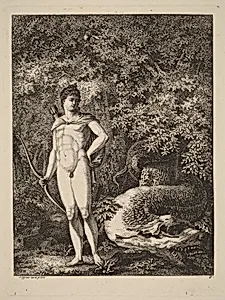
Apollo with a Bow and Dragon
1771
Medium
etching on laid paper
Dimensions
plate: 21.9 x 16.4 cm (8 5/8 x 6 7/16 in.) sheet: 27.9 x 38.4 cm (11 x 15 1/8 in.)
Classification
Department
CG-E
Museum
National Gallery of Art, Washington, D.C.
Credit
Ailsa Mellon Bruce Fund
Accession Number
1999.100.12
Rights
Public Domain
Art Historical Context
Salomon Gessner’s *Apollo with a Bow and Dragon*1771) is a captivating etching on laid paper, the Swiss artist’s mastery of classical mythology during the late Enlightenment era. Measuring a modest plate size of 21.9 x 16.4 cm, this print captures Apollo, the Greek god of music, poetry, and archery, poised with his bow against a formidable—likely alluding to the myth of Apollo slaying the serpent Python at Delphi. Gessner, a poet-painter celebrated for his idyllic landscapes and pastoral themes, infused his works with a Rococo elegance that bridged neoclassical revival and romantic sensibility. Etching, Gessner’s chosen medium, allowed for intricate line work and tonal depth through acid-etched copper plates, pressed onto laid paper with its characteristic chain lines for a textured, luminous effect. This technique was ideal for disseminating detailed imagery to a growing audience of art enthusiasts in 18th-century Europe, where prints democratized access to grand mythological narratives. Acquired through the Ailsa Mellon Bruce Fund for the National Gallery of Art’s print collection (Department CG-E), this piece highlights Gessner’s influence on European graphic arts. Visitors will appreciate its dynamic tension and refined detail, evoking the era’s fascination with heroic antiquity amid pastoral reverie.
About the Artist
Salomon Gessner · 1730–1788
Salomon Gessner was born in Zurich in 1730 into a family of printers and publishers, an upbringing that placed books, images, and ideas at the center of his world from an early age. Though largely self-taught as a visual artist, he received some instruction during a period in Berlin, where he encountered the German Rococo tradition, and his mature work reflects a deep absorption in the pastoral li...