
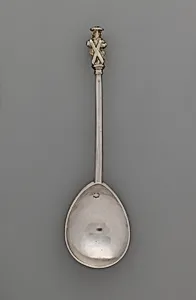
Apostle spoon: St. Andrew
1613–14
Medium
Silver, partly gilded
Dimensions
Overall: 2 × 7 3/16 in. (5.1 × 18.3 cm)
Classification
Metalwork-Silver
Culture
British, London
Department
European Sculpture and Decorative Arts
Museum
Metropolitan Museum of Art, New York, NY
Credit
Gift of Mr. and Mrs. James B. Mabon, 1967
Accession Number
67.166.13
Rights
Public Domain
Tags
Art Historical Context
This exquisite **Apostle spoon: St. Andrew**, by London silversmith Martin Hewitt 1613–14, exemplifies the fine metalwork of early Jacobean England. Made of silver with partial gilding—where a thin layer of gold enhances key details like the figure's robes or halo—the spoon measures a dainty 2 × 7 3/16 inches. At the top of its slender stem stands a finely modeled figure of St. Andrew, of Christ's apostles and patron saint of Scotland, identifiable by his traditional saltire cross. Apostle spoons like this were prized 16th- and 17th-century treasures, often produced in sets of 12 or 13 (including Judas or Christ) as christening gifts for the elite. Hewitt's mark confirms its London origin, a hub of silver craftsmanship regulated by guilds for quality. The gilding not only elevated its luxury but also protected the silver from tarnish, blending functionality with devotion. Today, housed in the Metropolitan Museum of Art's European Sculpture and Decorative Arts department (gift of Mr. and Mrs. James B. Mabon, 1967), it offers a glimpse into British cultural piety and the artistry of everyday objects turned sacred heirlooms.