
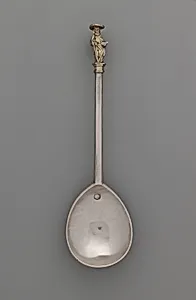
Apostle spoon: St. Philip
1592/93
Medium
Silver, partly gilded
Dimensions
Overall: 2 × 7 3/16 in. (5.1 × 18.3 cm)
Classification
Metalwork-Silver
Culture
British, London
Department
European Sculpture and Decorative Arts
Museum
Metropolitan Museum of Art, New York, NY
Credit
Gift of Mr. and Mrs. James B. Mabon, 1967
Accession Number
67.166.7
Rights
Public Domain
Tags
Art Historical Context
In the late Elizabethan era, London silversmith William Cawdell crafted this exquisite *Apostle spoon: St. Philip* around 1592–93, a hallmark of British metalwork from the period. Measuring just over 7 inches long, the spoon is made of silver with selective gilding—gold applied to enhance key details like the apostle's robes or halo—creating a luxurious contrast that symbolized wealth and piety. Housed in the Metropolitan Museum Art's European Sculpture andative Arts collection, it reflects the high craftsmanship of London's goldsmiths, who marked their work with hallmarks for authenticity and quality control. Apostle spoons like this one were prized 16th-century artifacts, often produced in sets of 12 (one for each apostle) or 13 (including Judas or Christ), given as christening gifts to nobility and affluent families. St. Philip, depicted here at the handle's finial, holds a traditional attribute like a basket of loaves, evoking biblical miracles. The technique of casting and chasing the figure demonstrates Cawdell's skill in capturing intricate details on a small scale, blending religious devotion with Renaissance humanism. This spoon offers a glimpse into Tudor England's material culture, where silverware doubled as heirlooms and status symbols. Its survival as a gift to the Met in 1967 underscores its enduring appeal, inviting us to appreciate the delicate artistry that once graced royal tables.