
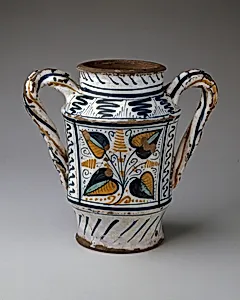
Apothecary Jar (albarello)
Unknown Artist
ca. 1470–90
Medium
Maiolica (tin-glazed earthenware)
Dimensions
H. 8 7/16 in. (21.4 cm)
Classification
Ceramics-Pottery
Culture
Italian, probably Florence or vicinity
Department
Robert Lehman Collection
Museum
Metropolitan Museum of Art, New York, NY
Credit
Robert Lehman Collection, 1975
Accession Number
1975.1.1059
Rights
Public Domain
Art Historical Context
This elegant apothecary jar, as an *albarello*, hails from Renaissance Italy, likely Florence or its vicinity, around 147–90. Crafted during a flourishing period of artistic innovation, these tall, waisted vessels were essential tools for apothecaries— pharmacists—who stored and dispensed herbal remedies, spices, and medicines. Their distinctive shape allowed them to stack neatly on shelves and display handwritten labels clearly, blending practicality with beauty in everyday life. Made of maiolica, or tin-glazed earthenware the jar showcases a prized Italian technique: a tin oxide glaze created a smooth, white canvas for vibrant painted decoration, fired at low temperatures to preserve rich colors. This method, influenced by Islamic ceramics via Spain and Sicily, peaked in Renaissance workshops, turning humble pottery into coveted art. Though the artist remains unknown, the piece reflects Florentine mastery, where ceramics rivaled painting and sculpture in refinement. Today, this 8 7/16-inch treasure from the Robert Lehman Collection at The Metropolitan Museum of Art offers a glimpse into 15th-century health practices and design ingenuity, reminding us how Renaissance artisans elevated the functional to the exquisite.