
Apothecary jar (albarello)
Unknown Artist
ca. 1530–40
Medium
Maiolica (tin-glazed earthenware)
Dimensions
Height: 7 15/16 in. (20.2 cm)
Classification
Ceramics-Pottery
Culture
Italian, Castelli
Department
Robert Lehman Collection
Museum
Metropolitan Museum of Art, New York, NY
Credit
Robert Lehman Collection, 1975
Accession Number
1975.1.1048
Rights
Public Domain
Tags
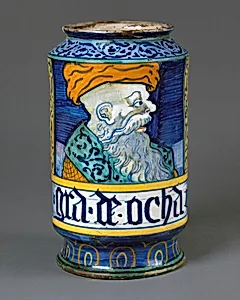
Art Historical Context
This elegant apothecary jar, known as an *albarello*, hails from Castelli, Italy, around1530–40, a hub of Renaissance ceramic production in the Abruzzo region.aped with a narrow waist for easy gripping and stacking in pharmacies, these jars stored spices, medicines, or confections, often labeled with their contents. Standing just under 8 inches tall, example exemplifies the practical yet beautiful wares that bridged everyday use and artistic expression during the Italian Renaissance. Crafted from maiolica—tin-glazed earthenware—the jar's surface gleams with a white tin oxide glaze over fired clay, creating a smooth canvas for vibrant, durable polychrome decoration. Artisans in Castelli mastered this technique, imported from Islamic Spain and perfected in Italy, allowing bold colors and intricate motifs like the male profiles adorning this piece. These stylized portraits evoke classical antiquity, reflecting the era's revival of ancient Roman aesthetics in everyday objects. Today, this anonymous masterpiece resides in the Metropolitan Museum of Art's Robert Lehman Collection, highlighting Castelli's pivotal role in Europe's ceramic renaissance. It offers a glimpse into 16th-century apothecary life, where form, function, and artistry converged.