
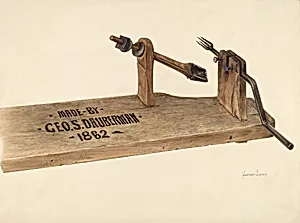
Apple Peeler
Medium
watercolor, graphite, and pen and ink on paper
Dimensions
overall: 30.5 x 41 cm (12 x 16 1/8 in.) Original IAD Object: overall: 30" long; 7" wide; uprights: 5" high and 5 3/4" high
Classification
Index of American Design
Department
CG-W
Museum
National Gallery of Art, Washington, D.C.
Credit
Index of American Design
Accession Number
1943.8.8350
Rights
Public Domain
Art Historical Context
**Apple Peeler**, a captivating rendering by artists H. Langden Brown and Milton Bevier around 1940, showcases a classic American kitchen tool from the 19th century. Created as part of the *Index of American Design*—a Works Progress Administration (WPA) project during the Great Depression—this watercolor, graphite, and pen-and-ink drawing on paper meticulously captures the device's practical form: an overall length of 30 inches, 7 inches wide, with uprights rising 5 to 5¾ inches high. Measuring 30.5 x 41 cm itself, the artwork preserves the peeler's whimsical yet functional design, blending wood and metal in a testament to everyday American ingenuity. The *Index of American Design* aimed to document the nation's rich heritage of folk art, crafts, and decorative objects, employing over 400 artists to produce more than 15,000 precise illustrations. Brown and Bevier's technique—layering vibrant watercolor washes with fine graphite details and ink outlines—brings a three-dimensional vibrancy to the flat page, highlighting textures and proportions with scientific accuracy. Housed in the National Gallery of Art's collection, this piece celebrates the cultural importance of utilitarian designs that powered rural households, evoking nostalgia for a time when simple machines transformed chores into feats of clever engineering. Today, it invites us to appreciate how ordinary tools embodied American resourcefulness, bridging art, history, and daily life.