
Arab Woman
1845–88
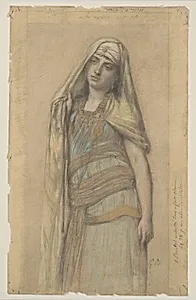
Medium
Black chalk, blue, yellow and white pastel, shell gold, with graphite
Dimensions
Sheet: 18 5/8 × 11 7/16 in. (47.3 × 29 cm)
Classification
Drawings
Department
Drawings and Prints
Museum
Metropolitan Museum of Art, New York, NY
Credit
Bequest of Harvey Salzman, 2020
Accession Number
2022.25.5
Rights
Public Domain
Tags
Art Historical Context
Gustave Boulanger's *Arab Woman*, created during his active years from 1845 to 1888, exemplifies the 19th-century French with Orientalism—a movement where European artists romanticized and exoticized Middle Eastern and North African cultures. Boulanger, a skilled academic painter and draftsman, often depicted such subjects with meticulous detail, drawing from travels and popular imaginations of the "Orient." This intimate drawing captures the poised elegance of its female subject, reflecting broader European trends in portraying "exotic" women as symbols of mystery and allure. Rendered on a modest sheet measuring 18 5/8 × 11 7/16 inches, the work employs a rich mixed-media technique: black chalk for bold outlines and shading, vibrant blue, yellow, and white pastels for luminous color, graphite for fine lines, and shell gold—a powdered gold suspended in a medium—for subtle, opulent highlights. This combination lends a jewel-like quality, elevating the drawing beyond mere sketch to a finished study, possibly preparatory for a larger painting. Such techniques showcase Boulanger's mastery in blending precision with atmospheric effects. Housed in the Metropolitan Museum of Art's Drawings and Prints department through the 2020 bequest of Harvey Salzman, *Arab Woman* invites visitors to ponder the interplay of beauty, cultural gaze, and artistic innovation in Orientalist art. A poignant reminder of how 19th-century visions shaped global perceptions.