
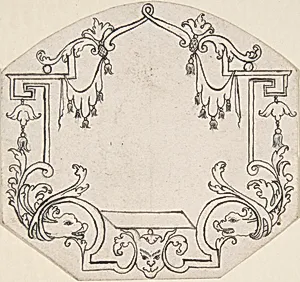
Arabesque Cartouche
18th century
Medium
Pen and black ink, graphite.
Dimensions
2 13/16 x 3 in. (7.1 x 7.6 cm)
Classification
Drawings
Department
Drawings and Prints
Museum
Metropolitan Museum of Art, New York, NY
Credit
Gift of H.A. Elsberg, 1927
Accession Number
27.70.3
Rights
Public Domain
Tags
About this artwork
"Arabesque Cartouche" by Anonymous, French, 18th century (French) from 18th century represents an important work in drawings. Created in pen and black ink, graphite., this work demonstrates technical skill and artistic vision. This drawing provides insight into artistic process. The artwork reflects aesthetic values of its time, offering insight into artistic practices and cultural context. It demonstrates the evolution of artistic expression and technical methods during this period. Held in a m...
Art Historical Context
This delicate *Arabesque Cartouche*, by an anonymous French artist in the 18th, exemplifies the ornate decorative arts of the Rococo era. Rendered in pen and black ink with graphite on a petite sheet measuring just 2 13/16 x 3 inches, it features intricate, flowing arabesque patterns—swirling foliage and fantastical motifs typical of French ornamental design. Such cartouches served as elegant frames for inscriptions, coats of arms, or titles in architecture, furniture, and book illustrations, showcasing the period's love for asymmetry and exuberant natural forms. In the opulent world of 18th-century France, under Louis XV's reign, arabesques like this reflected a shift from Baroque grandeur to lighter, more playful aesthetics. The anonymous draughtsman's precise ink lines, likely built on graphite underdrawings, highlight masterful control and technical virtuosity, offering a window into the preparatory sketches that fueled the decorative arts boom. This work captures the era's cultural emphasis on refinement and whimsy, bridging fine art and craft. Today, housed in the Metropolitan Museum of Art's Drawings and Prints department as a 1927 gift from H.A. Elsberg, it invites visitors to appreciate the unsung skill behind grand designs, reminding us how small sketches shaped Europe's lavish visual heritage.
About the Artist
Anonymous, French, 18th century · 1700–1800
The artist known as Anonymous, French, 18th century, represents a collective of unidentified talents active roughly between 1700 and 1800, a period of profound artistic evolution in France from the opulent Rococo to the austere dawn of Neoclassicism and Revolutionary fervor. Little is documented about their personal training or mentors, as their anonymity obscures individual biographies, though th...