
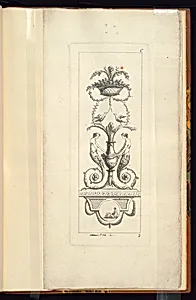
Arabesque Design
Classification
Department
Smithsonian Collection
Museum
Smithsonian American Art Museum
Credit
Purchased for the Museum by the Advisory Council
Accession Number
1921-6-257-14
Rights
Public Domain
About this artwork
Research in Progress
Art Historical Context
This elegant print, titled Arabesque Design, dates to around 1775 and is the work of French artist Juste-François Boucher (1736–1782). Created in the later years of the Rococo period, it reflects the era’s love of ornate, flowing decoration that French interiors, furniture, and the decorative arts under Louis XV and the early reign of Louis XVI. Arabesque patterns—featuring scrolling foliage, vines, and graceful curves—drew from both ancient Roman grotesques and Islamic ornament, becoming a hallmark of 18th-century European design. As a print, this work would have circulated these motifs among artisans, architects, and collectors, helping spread fashionable ideas across workshops and households. Prints like this played a vital role in the period’s visual culture, making sophisticated designs accessible beyond elite palaces. Now in the Smithsonian American Art Museum, the piece (acquired through the Advisory Council) offers a window into the transatlantic appreciation of French decorative arts. While research on its precise medium continues, it remains a charming example of how ornamental prints captured the playful elegance of a style on the cusp of Neoclassical change.