
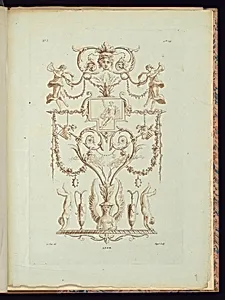
Arabesque Ornament Design
Medium
Classification
Department
Smithsonian Collection
Museum
Smithsonian American Art Museum
Credit
Purchased for the Museum by the Advisory Council
Accession Number
1921-6-337-7
Rights
Public Domain
About this artwork
Research in Progress
Art Historical Context
Pierre Thomas Le Clerc, a French engraver active in the late 18th century (. 1740–1796), created this *Arabesque Ornament Design as a print around 1788–89. Captured during the waning years of the Ancien Régime, just before the French Revolution, the work exemplifies the ornate decorative traditions of the Rococo and emerging Neoclassical styles. Arabesques—intricate, flowing motifs of vines, scrolls, and foliage—had roots in Islamic art but flourished in European design books, serving as templates for furniture, wallpaper, textiles, and architecture. As a print, Le Clerc's design was likely produced via etching or engraving, techniques that allowed precise replication and widespread dissemination among artisans and designers. These ornamental prints were essential tools in the decorative arts trade, bridging fine art and craftsmanship. Housed in the Smithsonian American Art Museum's collection (purchased by the Advisory Council), it highlights transatlantic influences, as such French designs inspired American Federal-style interiors. Though research continues, this piece invites us to appreciate the elegance of 18th-century ornamentation, where fantasy intertwined with utility, decorating the opulent spaces of Europe's elite.