
Arabesque Design
Classification
Department
Smithsonian Collection
Museum
Smithsonian American Art Museum
Credit
Purchased for the Museum by the Advisory Council
Accession Number
1921-6-335-27
Rights
Public Domain
About this artwork
Research in Progress
Art Historical Context
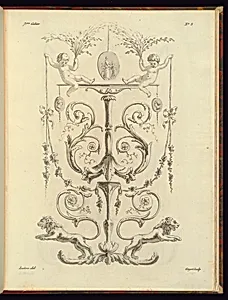
**Arabesque Design** by Pierre Thomas Le ClercFrench, ca. 1740–ca. 1796) is a captivating print from 1788, now housed in the Smithsonian American Museum's collection. Created during the late Enlightenment era in France, this work exemplifies the enduring fascination with arabesque motifs—intricate, flowing patterns inspired by Islamic art and adapted into European decorative traditions. Le Clerc, a skilled engraver, captured these whimsical interlacements of foliage, scrolls, and abstract forms, which were highly prized for their elegance and versatility. As a print, the artwork likely served practical purposes, such as a model for artisans crafting furniture, wallpapers, or architectural ornamentation during the transition from Rococo exuberance to Neoclassical restraint. Though the exact medium remains under research, prints like this democratized sophisticated design, allowing widespread dissemination of refined tastes across workshops and homes. Purchased for the museum by the Advisory Council, it highlights the Smithsonian's commitment to preserving 18th-century graphic arts that bridged art and craft. This delicate design invites visitors to appreciate the artistry in decoration, reminding us how patterns can evoke movement and fantasy in everyday spaces. Ongoing research promises to reveal even more about Le Clerc's techniques and influences.