
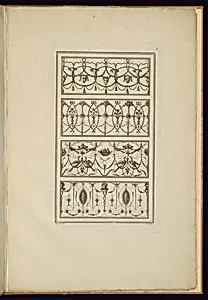
Arabesque Ornament Designs
late 18th century
Classification
Department
Smithsonian Collection
Museum
Smithsonian American Art Museum
Credit
Purchased for the Museum by the Advisory Council
Accession Number
1921-6-306-3
Rights
Public Domain
About this artwork
Research in Progress
Art Historical Context
Jean-Baptiste Fay, a French artist active from 1765 through the 1790s, created *Arabesque Ornament Designs in the late 18 century, a time when elaborate decorative motifs bridged the opulent Rococo style and emerging Neoclassicism. As a print in the Smithsonian American Art Museum's collection—purchased by the Advisory Council—this work exemplifies the era's fascination with arabesques: intricate, flowing patterns inspired by nature, vines, and exotic motifs, often borrowed from Islamic art and adapted for European interiors, furniture, and textiles. designs were highly practical, serving as pattern books for artisans and craftsmen. Prints like Fay's allowed intricate ornamentation to be widely disseminated, influencing everything from wallpaper to silverwork across Europe and beyond. Though the exact printing technique remains unknown amid ongoing research, such works highlight the print medium's role in democratizing high design, making sophisticated aesthetics accessible to a broader audience. Today, this piece invites us to appreciate the artistry of illusion—arabesques create a sense of endless movement and harmony, reflecting Enlightenment ideals of beauty in complexity. Housed in an American collection, it underscores transatlantic exchanges in decorative arts during a transformative period.