
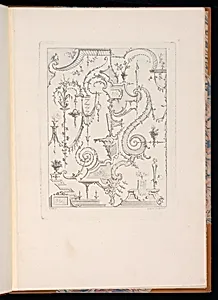
Arabesque Ornament Designs
Medium
Classification
Department
Smithsonian Collection
Museum
Smithsonian American Art Museum
Credit
Purchased for the Museum by the Advisory Council
Accession Number
1921-6-422-3
Rights
Public Domain
About this artwork
Research in Progress
Art Historical Context
Claude Gillot (1673–1722), a pioneering French artist and engraver, created these *Arabesque Ornament Designs as intricate patterns blending floral motifs, scrolls, and fantastical elements. Though Gillot died decades earlier, this print edition appeared between 1749 and 1761, reflecting the enduring popularity of his decorative work posthumously published for widespread use. Housed in the Smithsonian American Art Museum's collection it exemplifies the ornate arabesque style that bridged Baroque exuberance and the emerging Rococo lightness. Arabesques, with their rhythmic, interlacing forms inspired by ancient Roman grotesques and Eastern influences, were essential in 18th-century Europe for adorning architecture, furniture, and textiles. Gillot, mentor to Antoine Watteau, mastered such designs through his theater scenery and book illustrations, influencing the decorative arts across France. As a print—a revolutionary medium for replicating precise motifs—this work allowed artisans and designers to copy intricate details affordably, democratizing luxury ornamentation. Today, these designs offer a window into the playful elegance of pre-Revolutionary France, where fantasy met functionality in everyday luxury. Purchased for the museum by the Advisory Council, they invite visitors to trace the evolution of ornamental beauty. (198 words)