
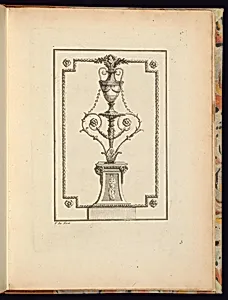
Arabesque Panel Design
Classification
Department
Smithsonian Collection
Museum
Smithsonian American Art Museum
Credit
Purchased for the Museum by the Advisory Council
Accession Number
1921-6-396-32
Rights
Public Domain
About this artwork
Research in Progress
Art Historical Context
**Arabesque Panel Design** by Juste-François Boucher (1736–1782), created between 1775 and 1788, exemplifies the elegant ornamental prints that graced late 18th-century French interiors. As the son of renowned Rococo master François Boucher, Juste-François carried forward his father's legacy of lavish decoration, blending fluid lines and intricate motifs in this classified print. Though the exact medium remains under study, such designs were typically etched or engraved, serving as blueprints for paneling, wallpaper, or furniture embellishments in aristocratic homes. Arabesques—swirling, interlacing patterns of foliage, scrolls, and fantastical elements—were a hallmark of French decorative arts during the waning Rococo era and the rise of Neoclassicism. This panel design captures that transitional spirit, offering a sense of playful abundance tempered by refined symmetry. Boucher's work reflects the opulence of pre-Revolutionary France, where such prints democratized high-style decoration for elite clientele. Acquired for the Smithsonian American Art Museum through the Advisory Council's purchase, this piece highlights transatlantic appreciation for European ornamental traditions. Ongoing research promises deeper insights, inviting visitors to ponder its role in shaping tastes across continents. (198 words)