
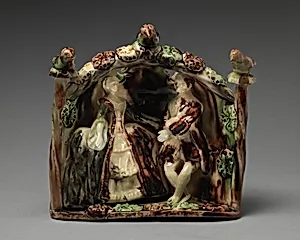
Arbor group
ca. 1755
Medium
Lead-glazed earthenware
Dimensions
6 1/2 × 7 in. (16.5 × 17.8 cm)
Classification
Ceramics-Pottery
Culture
British, Staffordshire
Department
European Sculpture and Decorative Arts
Museum
Metropolitan Museum of Art, New York, NY
Credit
Gift of Mrs. Russell S. Carter, 1944
Accession Number
44.39.39
Rights
Public Domain
Tags
Art Historical Context
This charming *Arbor Group*, created around 1755 in the "Whon type" style, exemplifies the vibrant ceramic artistry of Staffordshire, England. Attributed to the of pioneering potter Thomas Whon, these small-scale lead-glazed earthenware (measuring just 6½ × 7 inches) mass-produced for middle-class homes, bringing affordable whimsy to domestic interiors. The lead glaze technique, a hallmark of Whieldon, produced rich, mottled colors—often tortoiseshell-like greens, yellows, and blues—that mimicked more expensive porcelain while celebrating earthy, rustic motifs. Depicting men and women gathered in a leafy arbor with birds, the group captures 18th-century pastoral fantasies inspired by garden leisure and nature's harmony. Such figurines reflected the Rococo taste for playful, theatrical scenes amid the era's growing interest in outdoor pleasures and natural history. Housed in the Metropolitan Museum of Art's European Sculpture and Decorative Arts collection, this piece highlights Staffordshire's role as Britain's pottery powerhouse, blending technical innovation with cultural delight for everyday enjoyment.
About the Artist
Whieldon type
Whieldon-type is not a single artist but a catalogue attribution used by museums for unmarked mid-18th-century Staffordshire earthenware in the manner of Thomas Whieldon (1719-1795), the celebrated English potter of Fenton Vivian. Whieldon perfected lead-glazed cream-colored earthenware streaked and dappled with metallic oxides - manganese browns, copper greens, cobalt blues - producing the mottle...