
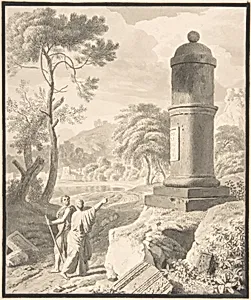
Arcadian Landscape
n.d.
Medium
Point of brush, gray ink and wash
Dimensions
sheet: 11 7/8 x 10 in. (30.2 x 25.4 cm)
Classification
Drawings
Department
Drawings and Prints
Museum
Metropolitan Museum of Art, New York, NY
Credit
Harry G. Sperling Fund and The Elisha Whittelsey Collection, The Elisha Whittelsey Fund, 2003
Accession Number
2003.89
Rights
Public Domain
Tags
Art Historical Context
Johannes Glauber's *Arcadian Landscape* invites viewers into an idealized pastoral world, where classical monuments rise gently amid rolling terrain and human figures suggest quiet contemplation. Created with point of brush, gray ink, and delicate washes, the drawing exemplifies the refined draftsmanship prized in the late seventeenth and early eighteenth centuries. The medium allows for both precise architectural detail and soft atmospheric effects, giving the scene a luminous, almost ethereal quality within its modest sheet size of roughly 12 by 10 inches. Glauber, active during the Dutch Golden Age, specialized in such Italianate views that blended observed nature with imagined antiquity. The presence of monuments and figures reflects the enduring appeal of Arcadia—a poetic realm drawn from ancient literature and revived in European art to evoke harmony between humanity and nature. Acquired by the Metropolitan Museum in 2003 through the Harry G. Sperling Fund and the Elisha Whittelsey Collection, this work enriches the museum’s holdings of Dutch drawings, offering visitors a glimpse into how artists used ink and wash to construct serene, timeless landscapes.
About the Artist
Johannes Glauber · 1646–1726
**Johannes Glauber (1646–c. 1726)** was a Dutch Golden Age painter renowned for his Italianate landscapes and decorative wall paintings. Born in Utrecht, he pursued art against the wishes of his father, the prominent chemist Johann Rudolph Glauber. He became a pupil of Nicolaes Berchem and lived for a time with Gerrit van Uylenburgh in Amsterdam, where he produced copies of Italianate landscapes f...