
Arch of Titus
Medium
Etching, with watercolor and gouache
Dimensions
Mat: 31 7/8 × 23 1/16 in. (80.9 × 58.5 cm) Image: 28 7/8 × 19 15/16 in. (73.4 × 50.7 cm)
Classification
Prints
Department
Drawings and Prints
Museum
Metropolitan Museum of Art, New York, NY
Credit
Gift of Mrs. Charles Wrightsman, 2009
Accession Number
2009.390
Rights
Public Domain
Tags
Art Historical Context
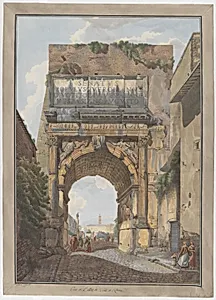
Step into ancient Rome through this exquisite etching of the *Arch of Titus*, a monumental triumphal arch erected in 81 CE to honor Emperor Titus's victory in the sack of Jerusalem. Captured here in intricate detail around 1780, the arch's carvings depict Roman soldiers carrying spoils like the golden Menorah from the Temple poignant symbol of imperial triumph and cultural exchange that still stands proudly in the Roman Forum today. Swiss artist Abraham Louis Rodolphe Ducros, renowned for his precise topographical views of Italian antiquities, collaborated with Italian engraver Giovanni Volpato to create this work. Using the etching technique—where acid etches fine lines into a metal plate for remarkable fidelity—they added vibrant watercolor and gouache, lending a luminous, hand-painted quality that evokes the sunlit stones of Rome. Produced during the Grand Tour era, when wealthy Europeans flocked to Italy for classical inspiration, this print served as a cherished souvenir blending artistry with scholarly reverence. Generously gifted to The Metropolitan Museum of Art in 2009 by Mrs. Charles Wrightsman, this 29-by-20-inch masterpiece invites visitors to ponder the enduring allure of Rome's ruins and the 18th-century passion for preserving antiquity through printmaking.
About the Artist
Abraham Louis Rodolphe Ducros|Giovanni Volpato · 1748–1810
Abraham Louis Rodolphe Ducros, born on July 21, 1748, in Moudon, Switzerland, was the son of Jean-Rodolphe Du Cros, a writing and drawing master who taught at Yverdon College after the family relocated there. Destined initially for commerce following his father's death in 1764, Ducros pursued art passionately. He trained for two years (1769–1771) under Chevalier Nicolas-Henri-Joseph de Fassin at a...