
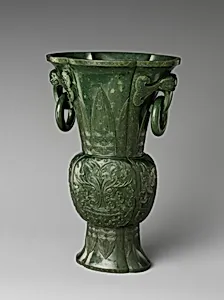
清乾隆 碧玉倣古活環花尊|Archaic-style vase with ring handles
Unknown Artist
Medium
Jade (nephrite)
Dimensions
H. 10 1/2 in. (26.7 cm)
Classification
Jade
Culture & Period
China · Qing dynasty (1644–1911), Qianlong period (1736–95)
Department
Asian Art
Museum
Metropolitan Museum of Art, New York, NY
Credit
Gift of Florence and Herbert Irving, 2015
Accession Number
2015.500.5.38
Rights
Public Domain
Art Historical Context
This exquisite Archaic-style vase with ring handles, crafted from vibrant green nephrite jade during the Qianlong period (1736–95) of China’s Qing dynasty (1644–1911), exemplifies the era’s fascination with antiquity. Standing at 10½ inches (26.7 cm) tall, its form draws inspiration from ancient bronze ritual vessels, a deliberate archaism (fǎ gǔ) popular under Emperor Qianlong, a devoted collector and patron of the arts. Imperial workshops transformed raw jade into these elegant objects, blending reverence for Zhou and Han dynasty bronzes with Qing technical prowess. Nephrite jade, prized in Chinese culture for symbolizing purity, virtue, and immortality, was meticulously carved to mimic the patina and motifs of archaic bronzes—think subtle taotie masks or floral bands—while featuring functional loose ring handles (huó huán). These vases, known as huā zūn, likely served as ornate displays for flowers or offerings in scholarly or imperial settings, highlighting jade’s status as a pinnacle of connoisseurship. A gift to the Metropolitan Museum of Art from Florence and Herbert Irving in 2015, this piece invites visitors to appreciate the Qianlong court’s masterful fusion of history and artistry, where every polished curve tells a story of cultural continuity.