
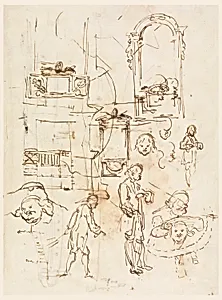
Architectural and Figural Sketches
Classification
architecture
Department
Smithsonian Collection
Museum
Smithsonian American Art Museum
Credit
Museum purchase through gift of various donors
Accession Number
1901-39-1150
Rights
Public Domain
About this artwork
Research in Progress
Art Historical Context
**Architectural and Figuraletches** by Carlo Marchni (Italian, 1702–1786), created around 1760, offers a glimpse into the creative mind of an esteemed 18th-century Italian architect. During this period, Italy was a hub of artistic innovation, blending the grandeur of Baroque traditions with the elegant curves of emerging Rococo styles. Marchionni, for his architectural projects in Rome such as palazzos and villas, often combined structural designs with lively figural elements to bring his visions to life on paper. These sketches, classified within architecture, likely served as preparatory studies, capturing ideas for buildings adorned with human forms—perhaps architects, workers, or allegorical figures—to emphasize scale and narrative. Though the medium remains unidentified amid ongoing research, such drawings were typically executed in ink, chalk, or graphite on paper, allowing artists like Marchionni to experiment fluidly before committing to stone or canvas. This piece highlights the iterative nature of architectural design in the Enlightenment era, where sketches bridged imagination and execution, influencing grand public spaces across Europe. Housed in the Smithsonian American Art Museum through generous donor gifts, it invites visitors to appreciate the humble origins of monumental architecture. (178 words)