
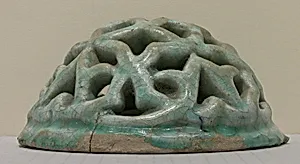
Architectural Boss
Unknown Artist
13th century
Medium
Stonepaste; molded, carved, and glazed
Dimensions
H. 2 5/8 in. (6.7 cm) D: 5 3/4 in. (14.6 cm) Diam. 5 3/4 in. (14.6 cm)
Classification
Ceramics-Tiles
Department
Islamic Art
Museum
Metropolitan Museum of Art, New York, NY
Credit
Anonymous Gift, 1974
Accession Number
1974.370.12
Rights
Public Domain
Art Historical Context
This exquisite *Architectural Boss*, crafted in the 13th, hails from the rich tradition of Islamic art and exemplifies the architectural splendor of the medieval Islamic world. Measuring just 2 5/8 inches high 5 3/4 inches in diameter this small yet impactful ceramic tile was designed as a decorative projection—likely for vaulted ceilings or structural intersections in mosques, palaces, or madrasas. Its compact form belies its role in enhancing grand interiors, where such bosses drew the eye upward in intricate patterns. Made of stonepaste (a fine-grained frit body prized for its porcelain-like translucency), the piece was skillfully molded into shape, intricately carved with motifs, and coated in a vibrant glaze. This multi-step technique, perfected by artisans in regions like Iran and Syria during the Seljuk and Mongol eras, allowed for delicate detailing and durability against wear. The glazing not only protected the surface but also amplified light reflection, creating a shimmering effect in architectural settings. As part of the Metropolitan Museum of Art's Islamic Art collection (anonymous gift, 1974), this boss offers a window into 13th-century innovation, where ceramics rivaled stone carving in opulence. It highlights how Islamic craftsmen blended functionality with beauty, turning everyday architecture into a canvas for spiritual and aesthetic elevation.