
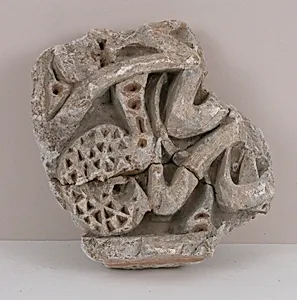
Fragment of a Frieze with Cursive Script
Unknown Artist
11th century
Medium
Plaster; carved and painted
Dimensions
H. 7 3/4 in. (19.7 cm) W. 7 1/2 in. (19.1 cm) D. 2 5/8 in. (6.7 cm) Wt. 34.4 oz. (975.333 g)
Classification
Plaster
Department
Islamic Art
Museum
Metropolitan Museum of Art, New York, NY
Credit
Rogers Fund, 1940
Accession Number
40.170.682
Rights
Public Domain
Art Historical Context
This delicate fragment of a frieze dating to the 11th century, offers glimpse into the refined world of Islamic architecture.ed from plaster that has intricately carved in low relief vividly painted, it measures just 7 3/4 inches high 7 1/2 wide, suggesting it adorned a larger architectural element, such as a mosque or wall. The central feature its flowing cursive script, a hallmark of early Islamic calligraphy emerged as artists developed more styles beyond rigid Kufic formsIn the Islamic artistic tradition calligraphy held profound cultural and significance, often conveying Quranic verses, poetry or invocations. Plaster or stucco, was favored medium for its workability, artisans to carve intricate patterns apply vibrant paints that caught light in grand interiors. This piece the era's emphasis onation without figurative imagery, technical skill with devotional purpose. Acquired through the Rogers Fund in 1940 and now housed in the Metropolitan Museum of Art's Islamic Art department, this fragment invites visitors to appreciate the enduring elegance of medieval Islamic design—where every curve of script tells a story of faith, craftsmanship, and beauty.