
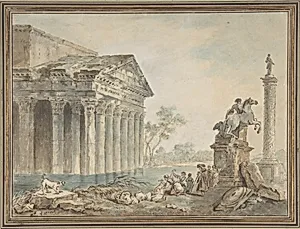
Architectural Capriccio with Roman Monuments and Washerwomen
Medium
Pen and black and gray ink, with brush and brown wash, and watercolor
Dimensions
9 3/16 x 12 5/16 in. (23.3 x 31.2 cm)
Classification
Drawings
Department
Drawings and Prints
Museum
Metropolitan Museum of Art, New York, NY
Credit
Bequest of Alexandrine Sinsheimer, 1958
Accession Number
59.23.69
Rights
Public Domain
Tags
Art Historical Context
Hubert Robert, the 18th-century French artist often called "Robert des Ru," masterfully captures the allure of antiquity in *Architectural Capriccio with Monuments and Washerwomen*. undated drawing exemplifies his signature style of *capricci*—whimsical, imaginary compositions blending real Roman ruins with everyday life. Towering ancient monuments, evocative of Rome's imperial past, frame a serene riverside scene where washerwomen go about their daily tasks, highlighting Robert's with the dialogue between majestic decay and humble human activity. Crafted in pen and black and gray ink, enhanced by brush and brown wash with watercolor, the work's intimate scale (9 3/16 x 12 5/16 inches) invites close viewing. These mixed media techniques create dramatic depth and atmospheric lighting, with washes softening edges to evoke the patina of time on stone. Robert's precise lines and subtle color gradients reflect the Neoclassical reverence for classical architecture during the Enlightenment era. Housed in the Metropolitan Museum of Art's Drawings and Prints department, this piece from the 1958 bequest of Alexandrine Sinsheimer offers a window into 18th-century Grand Tour fantasies. It reminds us how artists like Robert romanticized ruins, blending historical grandeur with poignant transience for enduring cultural resonance.
About the Artist
Hubert Robert|Hubert Robert · 1733–1808
Hubert Robert, born on May 22, 1733, in Paris, emerged from a modest background; his father, Nicolas Robert, served the influential Choiseul family, whose patronage shaped the young artist's path. After completing his studies at the Jesuit Collège de Navarre in 1751, he entered the atelier of sculptor Michel-Ange Slodtz, who taught him design and perspective before encouraging a shift to painting....