
Architectural Fragment
Ilkhanid dynasty (1256–1353), 13th century
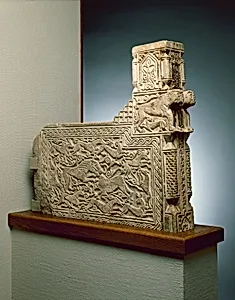
Medium
Limestone with carved decoration
Dimensions
72.6 × 12.2 × 77.5 cm (28 9/16 × 4 13/16 × 29 3/4 in.)
Classification
marble
Department
Arts of Asia
Museum
Art Institute of Chicago
Accession Number
60898
Rights
Public Domain
Art Historical Context
This exquisite Architectural Fragment hails from the Ilkid dynasty (12561353), a 13th-century Mongol-ruled era in Persia that fused Islamic, Persian, and Central Asian influences. Carved from limestone, this substantial piece—measuring 72.6 × 12.2 × 77.5 cm—likely once adorned a grand mosque, madrasa, or palace, showcasing the era's mastery of stonework in architectural embellishment. Ilkhanid art flourished under patrons like the Mongol khans, who embraced Islam and sponsored lavish building projects. The fragment's intricate carved decoration exemplifies Islamic ornamental traditions: rhythmic geometric patterns, arabesques, and possibly epigraphic scripts, all rendered in deep relief to catch the play of light in vaulted spaces. Such techniques highlighted artisans' precision, using chisels to create textured surfaces that evoked infinity and divine order, avoiding figurative imagery in line with aniconic principles. Today, housed in the Art Institute of Chicago's Arts of Asia department and classified as marble-like stone, this survivor offers a tangible glimpse into a transformative period. It reminds us how architecture served as a canvas for cultural synthesis, bridging conquest and creativity in the medieval Islamic world.
About the Artist
Islamic
Islamic art, a profound visual tradition originating in the 7th century CE, flourished across vast territories from Spain to India under Muslim rule, encompassing architecture, ceramics, manuscripts, textiles, and metalwork produced by diverse artisans rather than a single named master. Drawing from pre-Islamic Sasanian, Byzantine, and late antique influences, its early development under the Umayy...