
Architectural Model
Unknown Artist
1st–8th century
Medium
Stone
Dimensions
H. 2 5/16 × W. 1 1/4 in. (5.9 × 3.2 cm)
Classification
Stone-Sculpture
Culture
Mezcala
Department
Arts of Africa, Oceania, and the Americas
Museum
Metropolitan Museum of Art, New York, NY
Credit
Bequest of Arthur M. Bullowa, 1993
Accession Number
1994.35.699
Rights
Public Domain
Tags
Art Historical Context
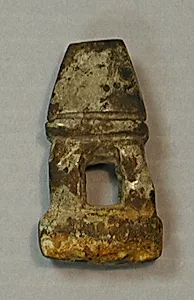
This petite stone architectural model, crafted by an unknown Mezcala artist between the 1st and 8th centuries, offers a rare glimpse into the sacred architecture of ancient Mesoamerica. Hailing from the Guerrero region of Mexico, the Mezcala culture— of the broader pre-Columbian world—produced these miniature sculptures as ritual objects, likely representing temples or ceremonial structures. At just 2 5/16 inches high and 1 1/4 inches wide, its compact form belies its cultural weight, evoking the stepped pyramids and enclosures central to Mesoamerican spirituality. Carved from hard stone with remarkable precision, the model showcases the Mezcala's mastery of subtractive techniques, polishing surfaces to highlight architectural details like roofs and walls. Such works were probably used in rituals or as votive offerings, bridging the earthly and divine realms. Though small, it reflects a sophisticated understanding of proportion and form, mirroring larger monumental temples that defined Mezcala society. Now housed in the Metropolitan Museum of Art's Department of the Arts of Africa, Oceania, and the Americas—thanks to the 1993 bequest of Arthur M. Bullowa—this artifact invites us to ponder the ingenuity of a culture whose legacy endures in these tiny, timeless forms.