
Architectural Study of Classical Entablature
19th century
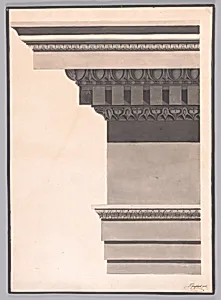
Medium
Pen and black ink with gray wash over black chalk
Dimensions
Sheet: 23 1/4 × 16 9/16 in. (59 × 42 cm)
Classification
Drawings|Ornament & Architecture
Department
Drawings and Prints
Museum
Metropolitan Museum of Art, New York, NY
Credit
Gift of Morrison Heckscher, 2016
Accession Number
2016.708.27
Rights
Public Domain
Tags
Art Historical Context
This meticulous *Architectural Study of Classicalablature*, attributed to F. or T. Grossbach in the 19th century captures the precise details of a cornerstone of classical architecture—the entablature, comprising the architrave,ieze, and cornice that crown columns in ancient Greek and Roman structures. Such drawings were vital tools for architects, draftsmen, and scholars during the neoclassical revival, when Europe and America embraced antiquity's grandeur to inform modern buildings, furnishings, and ornamentation. Executed on a generous sheet measuring 23¼ × 16⅜ inches, the work employs black chalk for initial underdrawing, followed by fine pen and black ink lines for crisp definition, and subtle gray wash to model light and shadow. This layered technique highlights Grossbach's skill in rendering three-dimensional form on paper, evoking the stone-carved elegance of temples like the Parthenon while demonstrating the era's emphasis on technical accuracy in architectural documentation. Housed in the Metropolitan Museum of Art's Drawings and Prints department (gift of Morrison Heckscher, 2016), this piece offers visitors a window into 19th-century pedagogical practices, where studying classical motifs preserved cultural heritage amid industrialization. It's a testament to drawing's enduring role in bridging past and present design.