
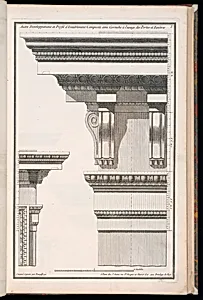
Autre Developpement et Profil d'Entablement Composite avec Corniche à l'usage des Portes et Fenêtres
Classification
Department
Smithsonian Collection
Museum
Smithsonian American Art Museum
Credit
Purchased for the Museum by the Advisory Council
Accession Number
1921-6-451-33
Rights
Public Domain
About this artwork
Research in Progress
Art Historical Context
Jean-François de Neufforge, a Flemish architect and engraver (1714–1791), created this intricate print in 1768 as part of his influential *Recueil élémentaire d'architecture*, a comprehensive pattern book that popularized neoclassical designs across Europe. Titled *Autre Developpement et Profil d'Entablement Composite avec Corniche à l'usage des Portes et Fenêtres*, it depicts the elevation and profile of a composite entablature—a decorative architectural element blending Ionic and Corinthian motifs—topped with a cornice, specifically adapted for doors and windows. As a print, likely etched or engraved, it exemplifies the precision of 18th-century reproductive techniques, allowing builders and designers to replicate classical forms with exactitude. During the Enlightenment, works like this bridged ancient Roman architecture with modern practice, fueling the Neoclassical revival amid growing interest in symmetry and proportion. Neufforge's ten-volume series, published in Paris, served as an accessible "grammar" of ornament for architects, carpenters, and amateurs, influencing structures from grand estates to urban facades. Acquired by the Smithsonian American Art Museum through its Advisory Council, this piece highlights the era's democratization of design knowledge. Though research continues, its survival underscores the enduring value of such prints as both art and practical tools, inviting us to appreciate the elegance of architectural detail in everyday spaces.