
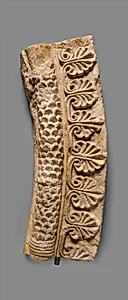
Archivolt fragment with vegetal design
Unknown Artist
ca. 6th century CE
Medium
Stucco
Dimensions
14 in. × 42 15/16 in. × 6 11/16 in. (35.6 × 109 × 17 cm)
Classification
Stucco-Architectural
Culture & Period
Sasanian · Sasanian
Department
Ancient Near Eastern Art
Museum
Metropolitan Museum of Art, New York, NY
Credit
Rogers Fund, 1932
Accession Number
32.150.2
Rights
Public Domain
Art Historical Context
This exquisite archivolt fragment, hailing from the Sasanian culture around the 6th century, offers a glimpse into the grandeur of ancient Persian architecture. Sasanians ruled a vast empire centered in modern-day Iran from 224 to 651 CE, renowned for their monumental palaces, fire temples, iwans—vaulted halls adorned with intricate decorations. An archivolt, the curved molding framing an archway, this stucco piece likely embellished such a structure, showcasing the empire's mastery of architectural ornamentation. Crafted from stucco—a versatile plaster medium molded and carved in situ—this 14 × 43 × 7-inch fragment (approximately) features a delicate vegetal design of intertwining vines and leaves. These motifs, evoking lush gardens and fertility, were hallmarks of Sasanian art, symbolizing paradise and imperial abundance. The low-relief carving technique allowed for fine detailing, blending functionality with aesthetic splendor, and influenced later Islamic decorative traditions. Acquired through the Rogers Fund in 1932 and housed in the Metropolitan Museum of Art's Ancient Near Eastern Art department, this fragment invites visitors to imagine the opulent settings it once graced, bridging the artistry of antiquity with our modern appreciation.