
Plaque
Unknown Artist
7th–8th century
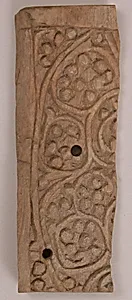
Medium
Bone; carved
Dimensions
H. 4 1/8 in. (10.5 cm) W. 1 1/2 in. (3.8 cm) D. 7/16 in. (1.1 cm)
Classification
Ivories and Bone
Department
Islamic Art
Museum
Metropolitan Museum of Art, New York, NY
Credit
Rogers Fund, 1938
Accession Number
38.118.8
Rights
Public Domain
Art Historical Context
This delicate carved bone plaque, dating to the 7th–8th century, hails from the early Islamic world, a time of profound cultural transformation following the rise of Islam. Crafted from bone—a lightweight, readily available material prized for its fine grain—this small object (just over 4 inches tall) exemplifies the exquisite craftsmanship of artisans in regions like Syria, Iraq, or Egypt under the Umayyad Caliphate. Such plaques were often used as inlays for furniture, harness fittings, or personal ornaments, blending utility with artistry. The intricate carving technique highlights the skill of anonymous workshops, where tools like burins and chisels etched detailed motifs into the bone's surface, achieving a smooth polish that catches the light. In Islamic art, bone objects bridged pre-Islamic traditions with emerging aniconic styles, favoring geometric patterns, arabesques, or vegetal designs over figural representation. This plaque's modest dimensions belie its cultural weight, offering a window into daily life and the spread of Islamic aesthetics across vast empires. Acquired through the Rogers Fund in 1938 and now housed in the Metropolitan Museum of Art's Islamic Art Department, it invites visitors to appreciate the subtlety of early Islamic ivories and bonework—testaments to ingenuity without ostentation.